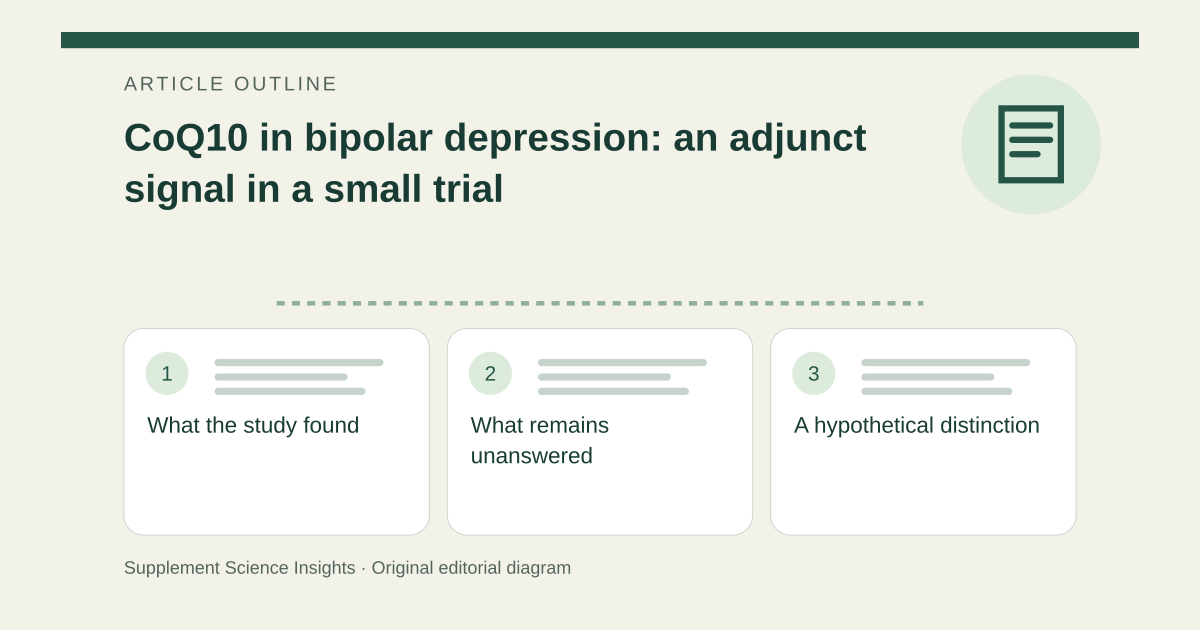
What the study found
Sixty-nine people with a current bipolar depressive episode were randomized to CoQ10 or placebo. Mood stabilizers and antidepressants were maintained before and during the eight-week study. [1]
Depression scores declined in both groups, with a greater improvement and more responders in the CoQ10 group at eight weeks. This was a short adjunct comparison in a particular psychiatric population. [1]
What remains unanswered
It does not establish treatment of every form of depression, prevention of future episodes or efficacy without the background medicines. Funding and conflicts were not established from the abstract. Proposed antioxidant mechanisms should remain hypotheses rather than being presented as proven explanations. [1]
A hypothetical distinction
Imagine a treatment is added to an existing regimen and the group improves more. Removing the existing regimen would create a different intervention that the experiment did not test.
| Detail | Interpretation |
|---|---|
| 69 participants | Small adjunct trial |
| Eight weeks | Short duration |
| Medicine replacement | Not studied |
Sources for this article
- Evaluating the Effect of Coenzyme Q10 Augmentation on Treatment of Bipolar Depression: A Double-Blind Controlled Clinical Trial - PubMed
Source consulted: 2026-09-19. This is a reference resource, not a claim that we conducted the studies or tested a product.