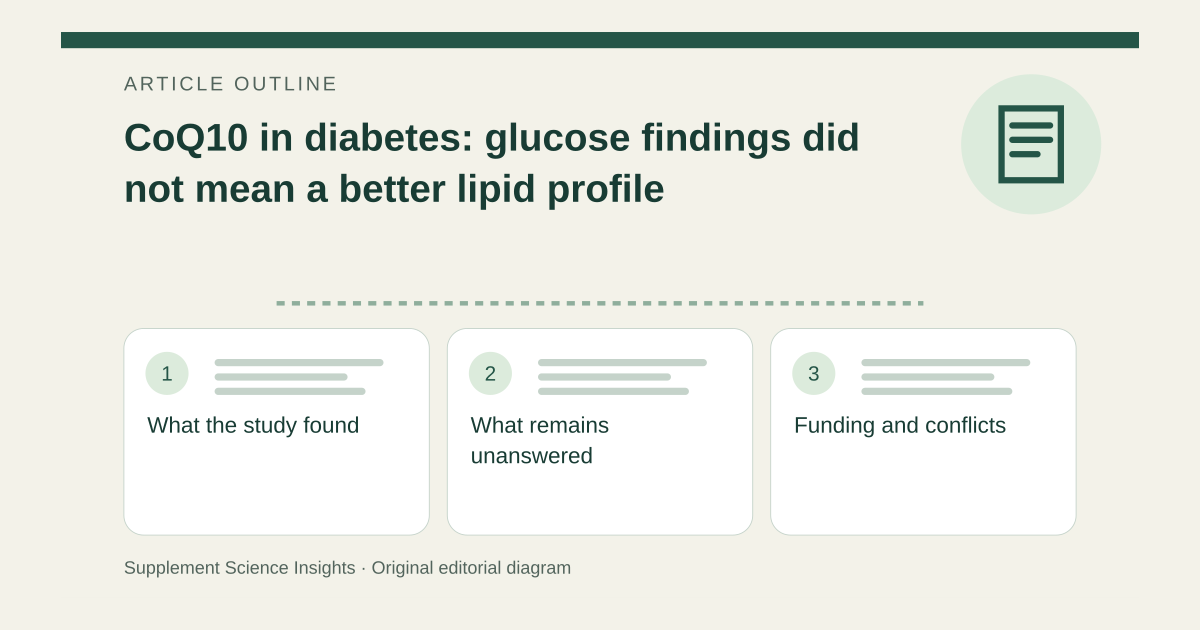
What the study found
Fifty people with type 2 diabetes were randomized in a double-blind trial to CoQ10 or maize-starch placebo for twelve weeks; forty completed the trial. The tested preparation supplied 150 mg daily in three 50 mg doses. Participants were younger than 75, had diabetes for at least a year and had HbA1c below 9%; insulin users and people with several major illnesses were excluded. [1][2]
At twelve weeks, fasting glucose and HbA1c were lower with CoQ10 than with placebo in the reported comparisons adjusted for baseline values. Insulin and HOMA-IR, an insulin-resistance estimate, did not differ significantly between groups. The changes from baseline within the CoQ10 group were not significant for these glycemic measures. [1][2]
The lipid results were mixed. LDL and total cholesterol were higher with CoQ10 than with placebo at the end of the trial. Triglycerides and HDL did not differ significantly between groups, although both fell within the CoQ10 group while LDL rose. A change within one group does not establish the difference caused by treatment. [1][2]
What remains unanswered
Four participants were lost to follow-up and six were excluded for taking less than 70% of the supplements, leaving twenty people in each analyzed group. Excluding one fifth of the randomized sample can affect the result; the report does not establish an intention-to-treat effect for everyone randomized. The small sample, selected population and twelve-week follow-up limit precision and applicability. [2]
These were blood-test outcomes, not evidence that CoQ10 prevents diabetic complications or replaces diabetes or cholesterol treatment. The paper measured several endpoints and reported statistical significance without confidence intervals for the treatment comparisons. Its findings do not establish the best dose or the clinical importance of the observed differences. [2]
Funding and conflicts
The study was supported by the Vice-Chancellor for Research at Iran University of Medical Sciences in Tehran. The authors declared no conflicts of interest. These are the paper’s disclosures; they do not remove the study’s methodological limitations. [2]
A hypothetical distinction
Imagine one blood test improves while another worsens. Labeling the entire profile improved would hide information needed to judge the intervention.
| Detail | Interpretation |
|---|---|
| 50 randomized | 40 completed |
| Glucose measures | Improvement signal |
| Lipid profile | Not uniformly favorable |
Sources for this article
- Effects of CoQ10 Supplementation on Lipid Profiles and Glycemic Control in Patients with Type 2 Diabetes: a randomized, double blind, placebo-controlled trial - PubMed
Source consulted: 2026-09-19. This is a reference resource, not a claim that we conducted the studies or tested a product. - Zahedi et al. (2014), Effects of CoQ10 Supplementation on Lipid Profiles and Glycemic Control in Patients with Type 2 Diabetes — full text
Source consulted: 2026-09-23. This is a reference resource, not a claim that we conducted the studies or tested a product.