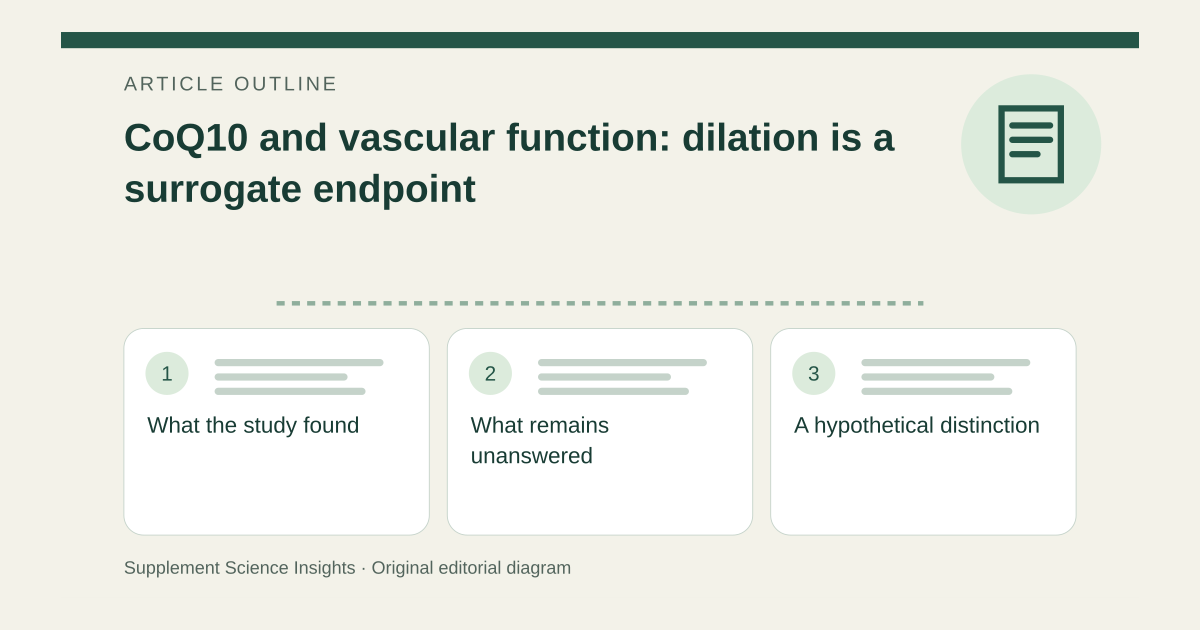
What the study found
Fifty-six people with ischemic left-ventricular systolic dysfunction were randomized to CoQ10 or placebo. Researchers measured brachial flow-mediated dilation and a lactate-to-pyruvate ratio used as a mitochondrial-function indicator. [1]
The CoQ10 group improved on those measures. Blood pressure, lipids, glucose measures and several inflammatory or oxidative markers did not significantly change relative to controls. [1]
What remains unanswered
A vascular response measurement is not the same as measuring nitric-oxide production directly, and correlated marker changes do not prove a causal pathway. The trial did not establish reduced heart attacks or mortality. Funding and conflicts were not established from the abstract. [1]
A hypothetical distinction
Imagine two markers improve together. One may help explain the other, but their correlation does not establish that changing the first caused the second.
| Detail | Interpretation |
|---|---|
| 56 patients | Specific heart condition |
| Flow-mediated dilation | Surrogate result |
| Clinical events | Not established |
Sources for this article
- Reversal of mitochondrial dysfunction by coenzyme Q10 supplement improves endothelial function in patients with ischaemic left ventricular systolic dysfunction: a randomized controlled trial - PubMed
Source consulted: 2026-09-19. This is a reference resource, not a claim that we conducted the studies or tested a product.