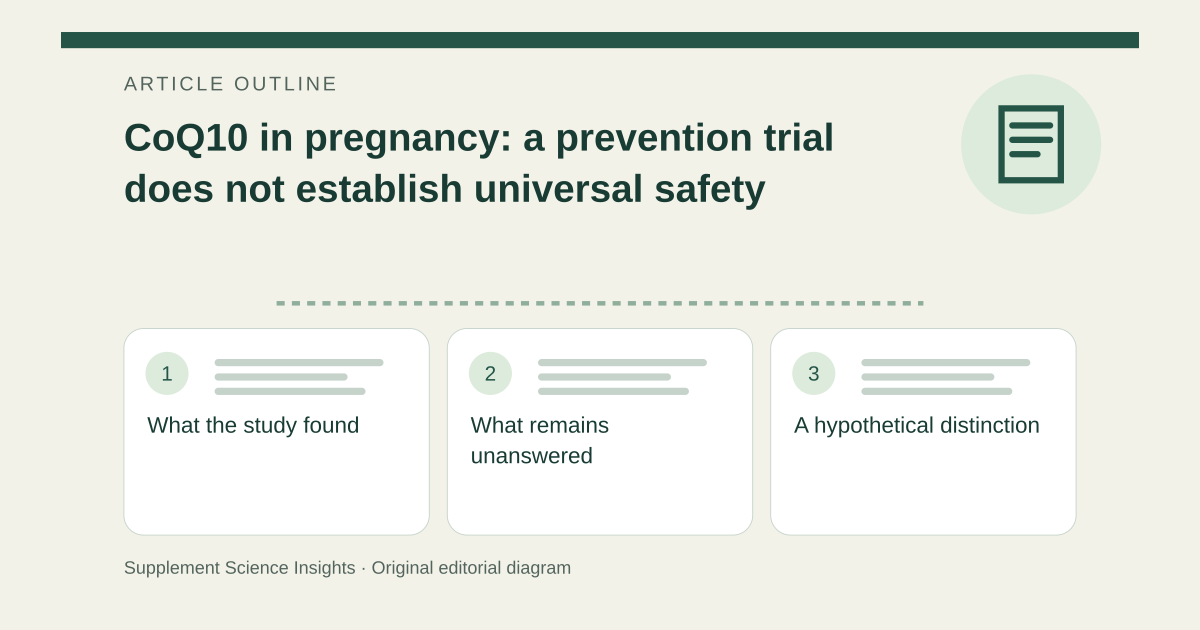
What the study found
The trial randomized 235 women to CoQ10 or placebo from 20 weeks of pregnancy until delivery. Follow-up was reported for 197, or 83.8%, of those enrolled. [1]
The intention-to-treat analysis reported pre-eclampsia in 14.4% of the CoQ10 group and 25.6% of controls. The study population had increased baseline risk. [1]
What remains unanswered
Incomplete follow-up and the specific population limit generalization. Starting at 20 weeks cannot establish first-trimester safety, and one trial does not provide blanket permission for use throughout pregnancy. Funding and conflicts were not established from the abstract; individual use requires obstetric review. [1]
A hypothetical distinction
Imagine a study begins after the first half of pregnancy. Even a favorable later outcome cannot directly answer what exposure during the earlier period would do.
| Detail | Interpretation |
|---|---|
| 235 randomized | 197 followed |
| Start at week 20 | Earlier exposure untested |
| Universal safety | Not established |
Sources for this article
- Coenzyme Q10 supplementation during pregnancy reduces the risk of pre-eclampsia - PubMed
Source consulted: 2026-09-19. This is a reference resource, not a claim that we conducted the studies or tested a product.