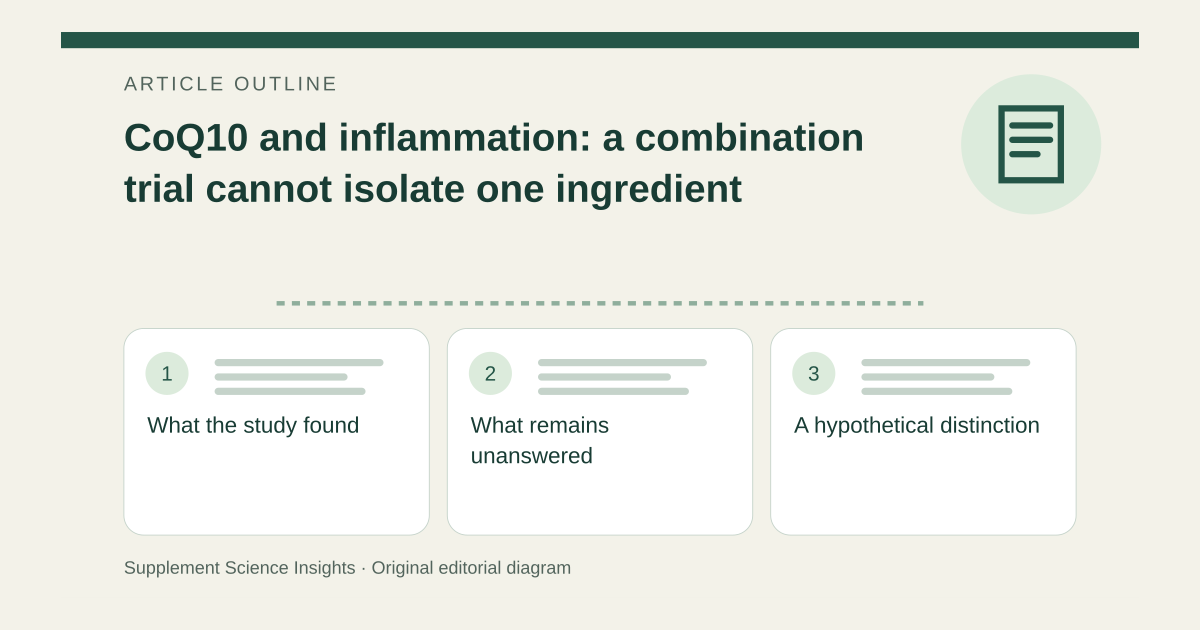
What the study found
A study of 437 older adults compared selenium plus CoQ10 with placebo during a four-year intervention. A secondary analysis examined CRP and soluble P-selectin alongside mortality follow-up. [1]
Marker trajectories favored combined supplementation. The authors characterized the analysis as hypothesis-generating, which is narrower than proof that CoQ10 treats all inflammatory conditions. [1]
What remains unanswered
Both ingredients changed together. The design cannot identify how much either ingredient contributed or whether a similar effect occurs in younger people or other nutritional settings. The authors declared no competing interests; funding was not established from the retrieved abstract. [1]
A hypothetical distinction
Imagine a recipe changes two ingredients and produces a different result. Without separate single-ingredient comparisons, the result cannot be assigned confidently to just one change.
| Detail | Interpretation |
|---|---|
| Two active ingredients | Attribution limited |
| Secondary analysis | Hypothesis-generating |
| Inflammatory disease treatment | Not established |
Sources for this article
- Levels of sP-selectin and hs-CRP Decrease with Dietary Intervention with Selenium and Coenzyme Q10 Combined: A Secondary Analysis of a Randomized Clinical Trial - PubMed
Source consulted: 2026-09-19. This is a reference resource, not a claim that we conducted the studies or tested a product.