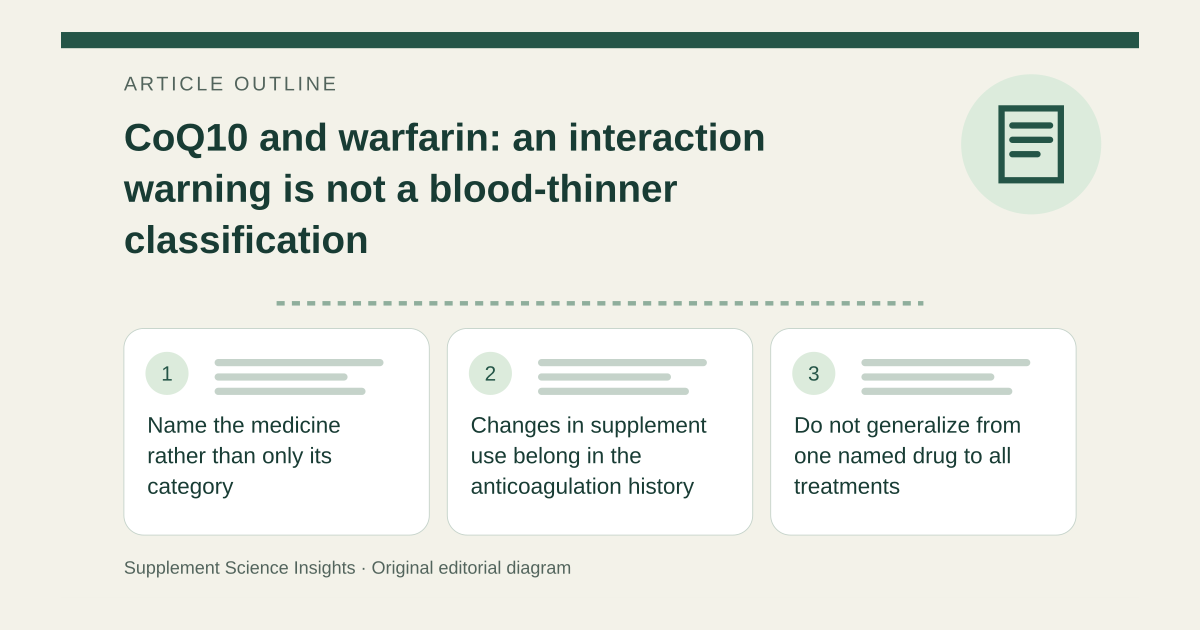
Name the medicine rather than only its category
NCCIH’s CoQ10 safety summary identifies a possible interaction with warfarin, as well as separate concerns involving insulin and some cancer treatments. A warning about warfarin should not be rewritten as a complete assessment of every anticoagulant or antiplatelet medicine. [1]
Nor does an interaction warning establish that CoQ10 is itself an appropriate blood thinner. The supplement’s natural presence in the body supplies no evidence that it prevents clots or replaces a prescribed anticoagulant. [1]
Changes in supplement use belong in the anticoagulation history
The practical issue is coordinated review of the exact supplement, amount, other ingredients and intended use. Tell the prescribing or anticoagulation team about planned changes so they can decide what monitoring or management is appropriate. [1]
The cited NCCIH page was updated in January 2019. It supports this specific caution, not a current comprehensive interaction database. It supplies no universal spacing interval or instruction for independently adjusting warfarin. [1]
Do not generalize from one named drug to all treatments
Imagine a product discussion says CoQ10 may interact with warfarin, but a reader uses another medicine. The named warning raises a review question; it does not prove the same interaction or establish compatibility with the other drug. The actual medicine must be assessed.
| Question | What matters |
|---|---|
| Warfarin warning | Specific identified concern |
| Different medicine | Separate assessment needed |
| Spacing by a few hours | Not established as a solution |
Sources for this article
- NCCIH: Coenzyme Q10
Source consulted: 2026-09-17. This is a reference resource, not a claim that we conducted the studies or tested a product.