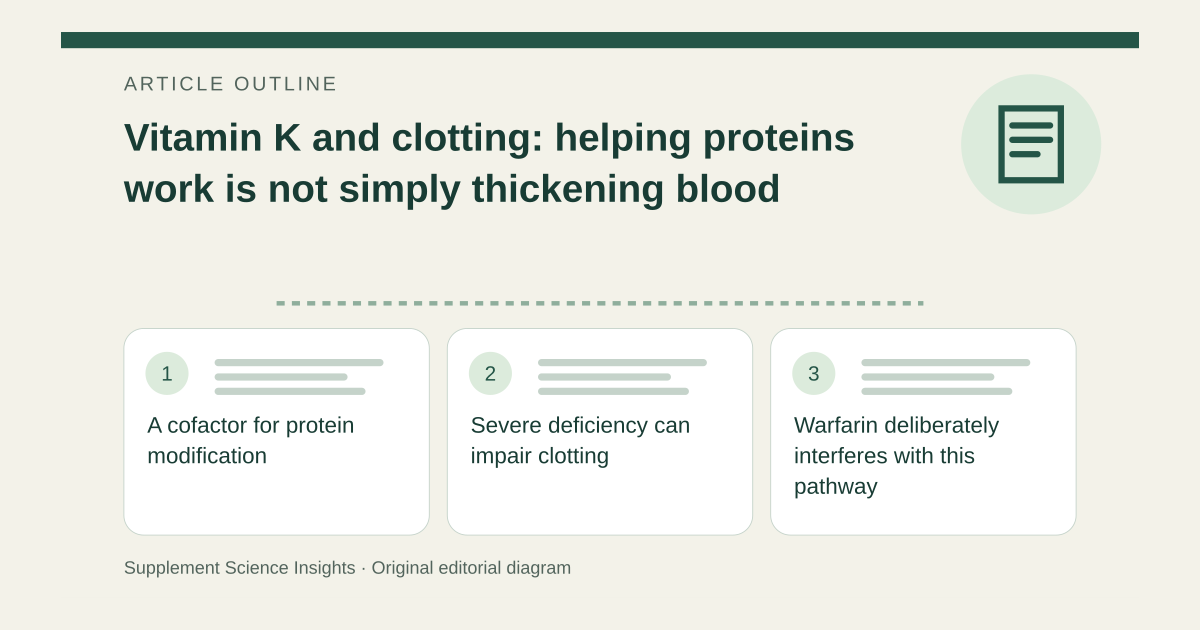
A cofactor for protein modification
Vitamin K acts as a cofactor for an enzyme involved in modifying vitamin-K-dependent proteins. One is prothrombin, or clotting factor II, which participates directly in blood clotting. This is a biochemical role in normal hemostasis. [1]
The description is more specific than saying the vitamin mechanically thickens the blood. It does not imply that taking extra vitamin K above an adequate intake necessarily increases clot formation in a healthy person. [1]
Severe deficiency can impair clotting
When vitamin K is severely deficient, prothrombin activity falls and clotting time can increase. Bleeding is the classic clinical concern. ODS notes that ordinary intake changes rarely alter standard clotting measures in healthy people. [1]
That distinction prevents a misleading inference: the consequences of severe deficiency do not prove that extra supplementation improves clotting beyond normal function. Unexplained bleeding also has causes other than vitamin K deficiency. [1]
Warfarin deliberately interferes with this pathway
Warfarin and related vitamin K antagonists reduce vitamin-K-dependent clotting activity. Sudden changes in vitamin K intake can therefore change the medicine’s effect, which is why consistency matters during treatment. [1]
This interaction does not establish the same food rule for every medicine described as a blood thinner. The exact prescription and its mechanism should be checked with the treating team. [1]
A food claim cannot adjust an anticoagulant
Imagine someone on warfarin tries to correct a laboratory result by eating a large serving of greens or taking a vitamin K tablet. A nutrient’s known mechanism does not establish the appropriate treatment response.
The anticoagulation team needs the result, intake history and medication information. This example explains why self-adjustment based on “thicker” or “thinner” blood language is unreliable.
| Point | Interpretation |
|---|---|
| Normal vitamin K function | Supports clotting-protein activity |
| Severe deficiency | Can impair clotting |
| Warfarin treatment | Needs consistent intake and supervised management |
Sources for this article
- NIH ODS — Vitamin K: Health Professional Fact Sheet
Source consulted: 2026-09-17. This is a reference resource, not a claim that we conducted the studies or tested a product.