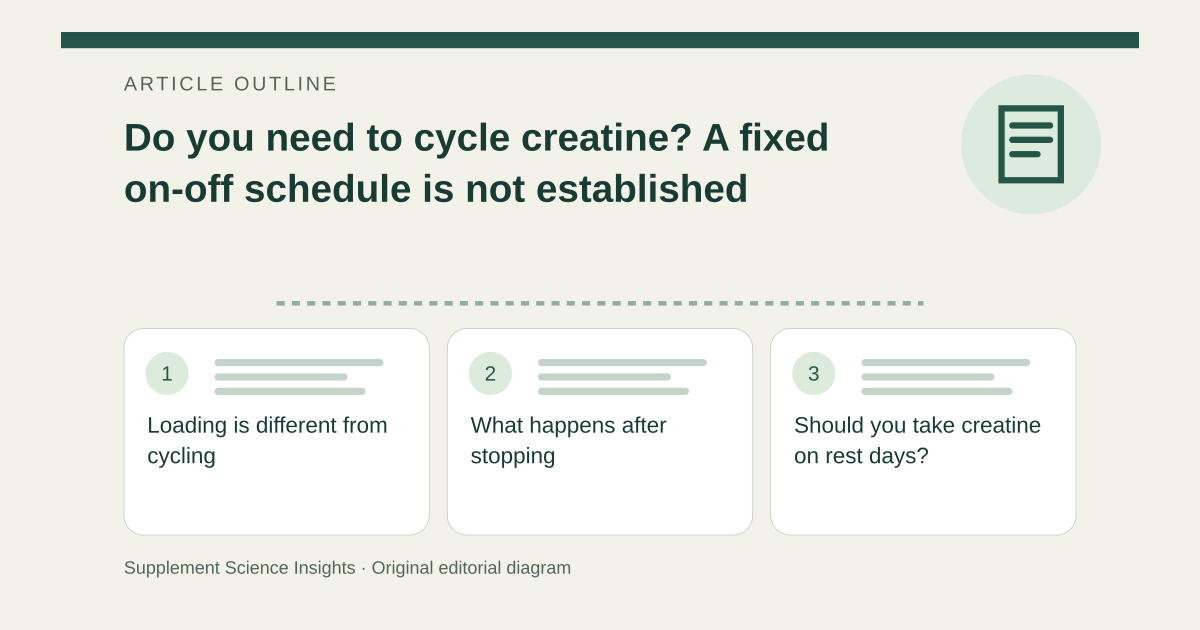
Loading is different from cycling
A loading phase aims to raise muscle stores more quickly; maintenance supports those stores. Cycling means periodically stopping and restarting. Evidence describing a loading protocol does not by itself establish a need for repeated off-periods. Lower daily intake protocols without loading are also described in ODS guidance. [1]
What happens after stopping
The ISSN position stand describes muscle stores returning toward baseline over roughly four to six weeks and does not report a fall below baseline from long-term suppression of synthesis. This is an expert synthesis, not a guarantee of an identical timeline for every person. It does not prove lifetime safety in every medical population. [2]
Should you take creatine on rest days?
Yes, a daily maintenance regimen includes non-training days. Its purpose is to maintain muscle creatine stores over time, rather than supply an immediate workout stimulant. The ISSN position stand describes daily maintenance, commonly 3–5 g in the studied adult sports context; this is not a personal prescription for every age or medical condition. [3]
A rest day does not require a new loading phase. The same position stand reports that elevated stores generally return toward baseline over several weeks after stopping, not after one missed workout. Follow the agreed product or clinical plan rather than doubling a serving to compensate for a missed day. [3]
A purposeful break
Imagine someone pauses because the product causes symptoms, their training goal changes or their clinician requests reassessment. Those are practical reasons distinct from an obligatory reset cycle. Do not use an online on-off schedule to manage kidney disease or an unexplained adverse effect; get advice about the underlying issue. [1]
| Hypothetical schedule | Meaning |
|---|---|
| Initial loading then maintenance | Store-building strategy |
| Mandatory monthly reset | Not established by these sources |
| Pause for symptoms or changed goals | Individual reassessment |
Sources for this article
- Dietary Supplements for Exercise and Athletic Performance - Health Professional Fact Sheet
Source consulted: 2026-09-20. This is a reference resource, not a claim that we conducted the studies or tested a product. - International Society of Sports Nutrition position stand: safety and efficacy of creatine supplementation in exercise, sport, and medicine - PMC
Source consulted: 2026-09-20. This is a reference resource, not a claim that we conducted the studies or tested a product. - ISSN position stand: creatine supplementation, supplementation protocols
Source consulted: 2026-09-25. This is a reference resource, not a claim that we conducted the studies or tested a product.