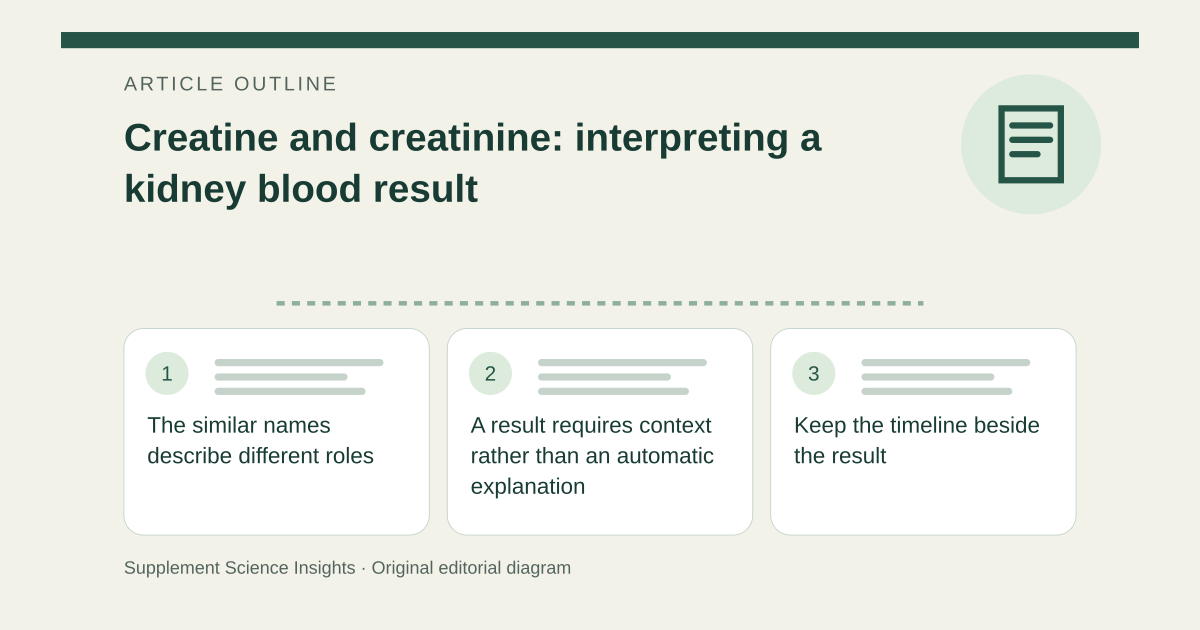
The similar names describe different roles
Creatine participates in the muscle energy system. Creatinine is a breakdown product removed through the kidneys. Kidney assessment commonly uses blood creatinine, so the distinction matters when a person reports taking creatine. [1][2]
The 2021 review explains that supplement use, meat intake and muscle-related factors can affect creatinine. A change in its concentration is therefore not a direct measurement of damaged kidney tissue. [1][2]
A result requires context rather than an automatic explanation
The review cautions about interpreting creatinine-based estimates of filtration in people using creatine. Tell the clinician what product and amount were used, when use began and whether other products are involved. [2]
This does not mean that every abnormal result is harmless or supplement-related. The clinician must assess the trend, symptoms, medical history and appropriate additional evaluation. This page does not supply a conversion formula or a self-directed testing washout. [2]
Keep the timeline beside the result
Imagine someone has a higher creatinine result after starting a creatine supplement. The sequence is useful information, but it cannot by itself distinguish a measurement-related change from a separate kidney problem.
A record of the start date and exposure helps the clinician investigate; discarding the abnormal result would lose information.
| Observation | Interpretation |
|---|---|
| Supplement start date | Adds timing information |
| Creatinine result and previous results | Preserves the observed trend |
| A temporal association | Does not establish the cause |
Healthy-adult findings are not kidney-disease clearance
The reassuring kidney findings discussed in the review primarily concern healthy people using studied amounts. They should not be converted into a universally safe dose for existing kidney disease. [1][2]
The review was published in 2021 and discloses creatine-industry relationships among several authors. Its cited trials were not independently reappraised here; an individual kidney decision remains clinical. [1][2]
Sources for this article
- NIH ODS: Dietary Supplements for Exercise and Athletic Performance
Source consulted: 2026-09-17. This is a reference resource, not a claim that we conducted the studies or tested a product. - Antonio et al. (2021): Common questions and misconceptions about creatine supplementation
Source consulted: 2026-09-17. This is a reference resource, not a claim that we conducted the studies or tested a product.