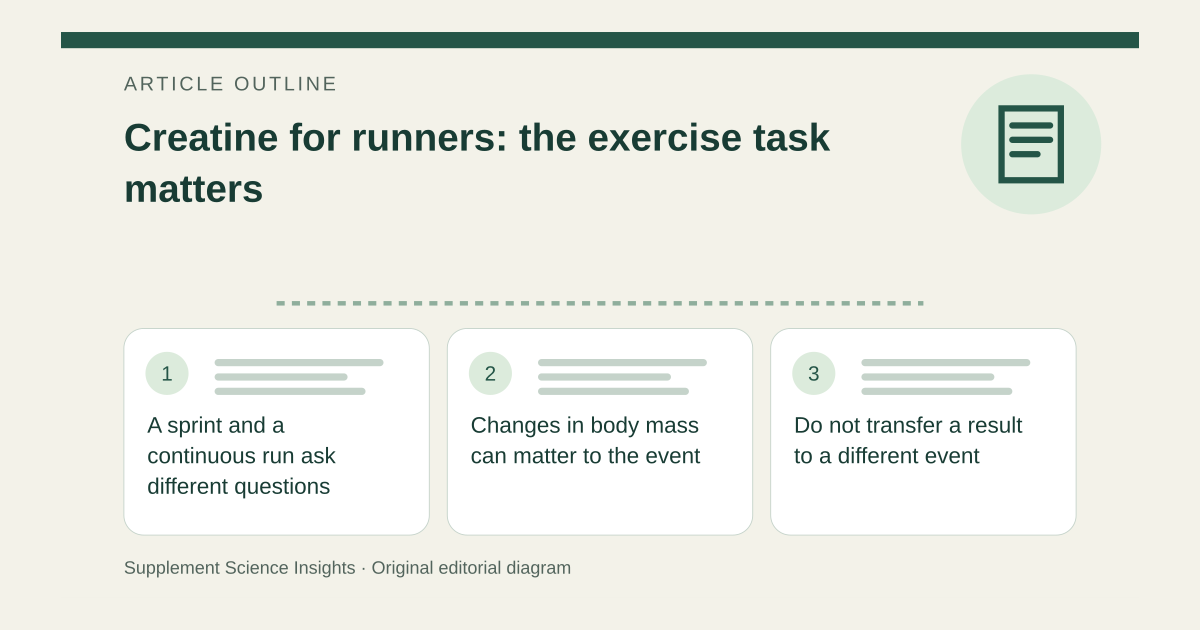
A sprint and a continuous run ask different questions
NIH ODS summarizes benefits for strength, power and work during maximal muscle contractions, while describing little value for endurance sports. The event and the outcome being measured matter. [1]
A runner may also perform strength training or repeated sprints, but improvement in those tasks should not automatically be reported as a faster marathon time. [1]
Changes in body mass can matter to the event
ODS identifies water-related weight gain as a possible effect. Its significance depends on the sport, training goal and individual response rather than being uniformly beneficial or harmful. [1]
The relevant comparison is performance in the intended task, with both benefits and unwanted effects measured. This summary does not prescribe a personal regimen or promise an endurance improvement. [1]
Do not transfer a result to a different event
Imagine a study improves repeated sprint output. That finding does not establish improved pace during an uninterrupted two-hour run.
| Detail | Interpretation |
|---|---|
| Repeated maximal effort | Better-supported context |
| Continuous endurance | Different outcome |
| Mass changes | May affect the tradeoff |
Sources for this article
- Dietary Supplements for Exercise and Athletic Performance - Health Professional Fact Sheet
Source consulted: 2026-09-18. This is a reference resource, not a claim that we conducted the studies or tested a product.