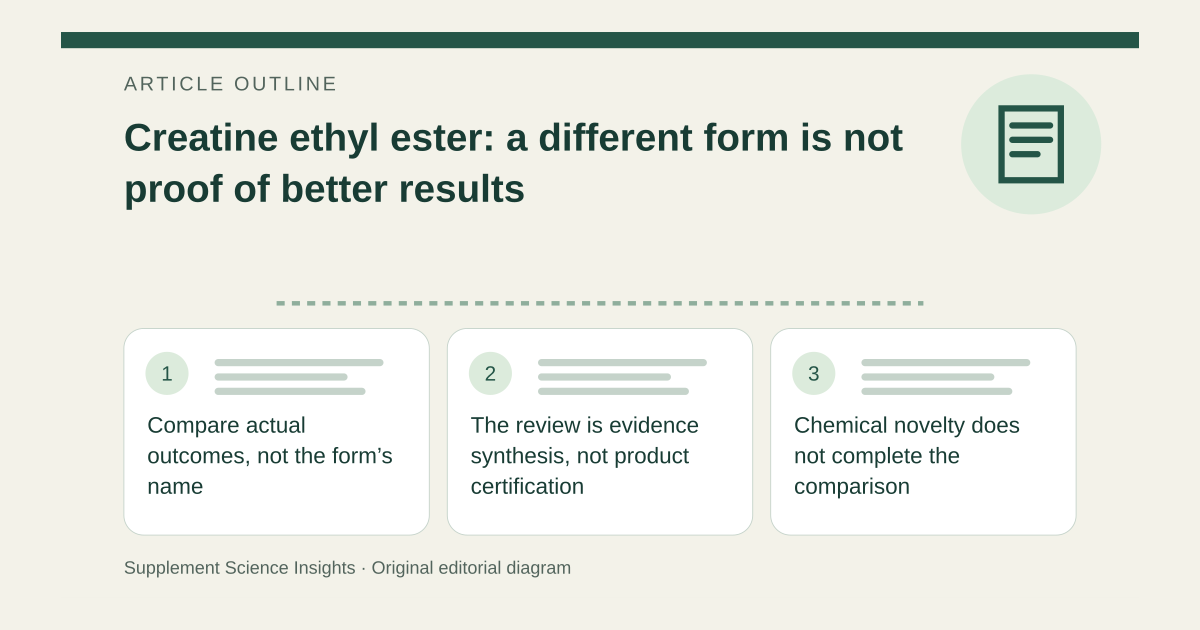
Compare actual outcomes, not the form’s name
The cited 2021 review includes creatine ethyl ester among alternatives that had not demonstrated greater muscle creatine storage than equal amounts of creatine supplied as monohydrate. It separates marketing claims from measured physiological outcomes. [1]
A claim of improved absorption should identify what was measured and whether it translated into a relevant performance benefit. A blood marker alone is not the same as muscle uptake or training adaptation. [1]
The review is evidence synthesis, not product certification
Several authors disclose creatine-industry relationships. This page reports the review’s comparison and does not independently appraise every original trial or certify a currently sold product. [1]
The source also does not establish identical effects from unequal amounts of different compounds. Keep ingredient identity and the amount of creatine supplied attached to the comparison. [1]
Chemical novelty does not complete the comparison
Imagine a label calls an ester advanced but provides no comparative outcome evidence. The descriptor does not establish an advantage over monohydrate.
| Detail | Interpretation |
|---|---|
| Ethyl ester | Different chemical form |
| Muscle storage | Relevant physiological outcome |
| Marketing term | Not comparative proof |
Sources for this article
- Common questions and misconceptions about creatine supplementation: what does the scientific evidence really show? | Journal of the International Society of Sports Nutrition | Springer Nature Link
Source consulted: 2026-09-18. This is a reference resource, not a claim that we conducted the studies or tested a product.