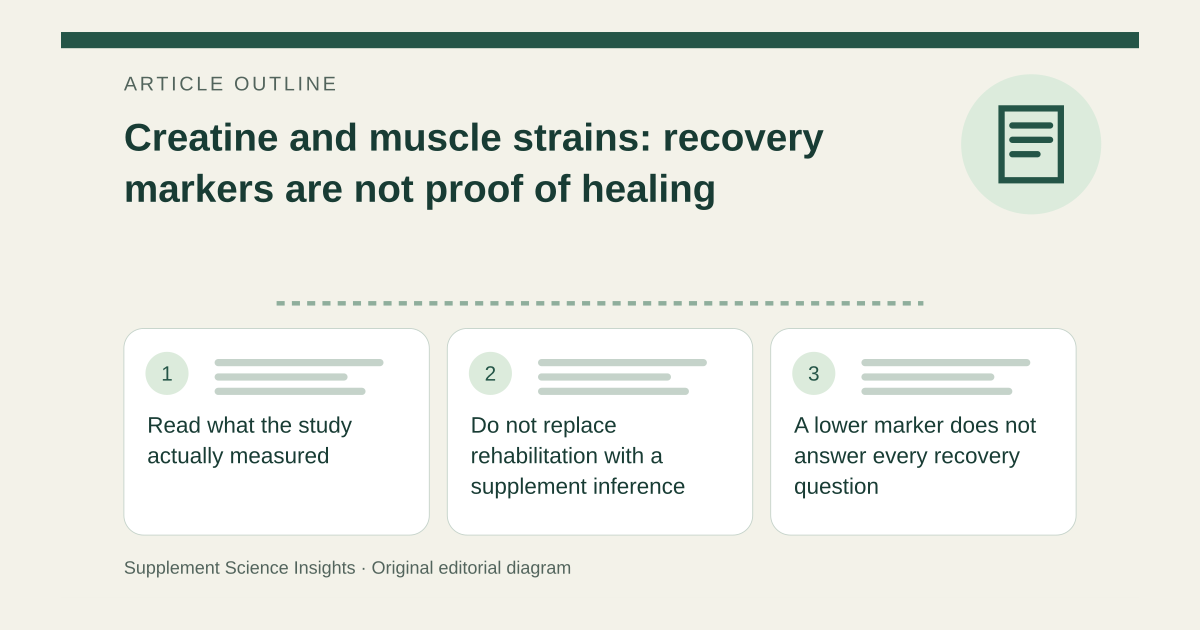
Read what the study actually measured
The cited review discusses studies of exercise-related muscle damage, including enzyme release and maintained muscle performance. These measurements can be useful without directly proving faster repair of a torn or strained muscle. [1]
An exercise protocol in volunteers and a clinical injury requiring rehabilitation are not interchangeable populations or exposures. [1]
Do not replace rehabilitation with a supplement inference
The 2021 review includes authors with supplement-industry relationships and is not a dedicated clinical guideline for treating muscle strains. Its recovery discussion should not be converted into a promise of a shorter healing time. [1]
An injury needs an appropriate diagnosis and rehabilitation plan. A proposed supplement addition should be discussed within that plan rather than used to justify returning to activity before recovery. [1]
A lower marker does not answer every recovery question
Imagine an intervention lowers a blood muscle-enzyme marker after exercise. That does not independently demonstrate earlier safe return to sport after a diagnosed tear.
| Detail | Interpretation |
|---|---|
| Soreness or enzyme marker | One recovery measure |
| Tissue healing | Different outcome |
| Return to sport | Clinical and functional decision |
Sources for this article
- Common questions and misconceptions about creatine supplementation: what does the scientific evidence really show? | Journal of the International Society of Sports Nutrition | Springer Nature Link
Source consulted: 2026-09-18. This is a reference resource, not a claim that we conducted the studies or tested a product.