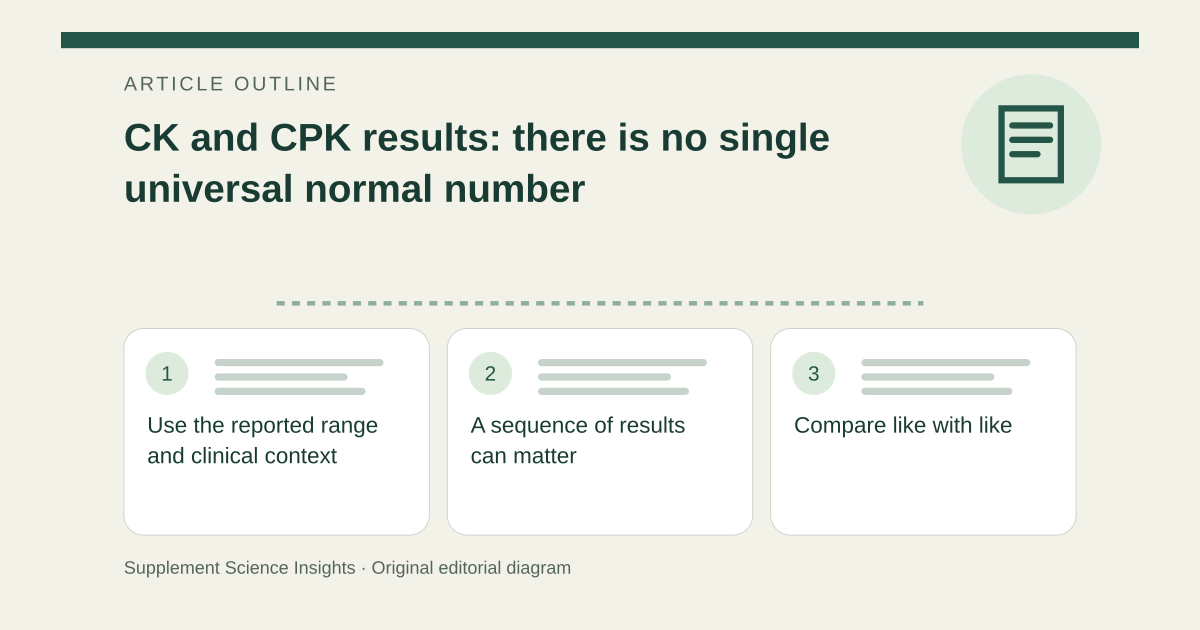
Use the reported range and clinical context
MedlinePlus notes that expected CK values vary with factors including muscle mass and physical activity. Recent intense exercise can contribute to an elevated result. A number copied from another laboratory is not a complete interpretation. [1]
An elevated CK suggests muscle injury but does not, on its own, identify where the injury occurred or what caused it. Symptoms, medical history and other tests may be needed. [1]
A sequence of results can matter
Creatinine is a normal waste product associated with muscle activity that the kidneys remove from the blood. Its measurement helps assess kidney function, often through an estimated filtration rate and other tests. CK testing instead measures an enzyme used in assessing tissue injury. The similar names do not make these two tests interchangeable. [1][2]
CK may rise after an injury rather than reaching its maximum immediately. Clinicians sometimes repeat the measurement to see whether it is increasing or decreasing. [1][2]
The names also matter: creatine kinase is an enzyme, while creatinine is a different laboratory analyte. A CK result should not be substituted for a creatinine result or interpreted simply as a measure of creatine supplement intake. [1][2]
Compare like with like
Imagine a CK result follows an unusually strenuous workout. Report that activity when discussing the result instead of diagnosing a muscle disease from the number alone. The clinician can assess whether repeat or additional testing is appropriate.
| Detail | Interpretation |
|---|---|
| CK / CPK | Creatine kinase enzyme |
| Recent exercise | Relevant context |
| One elevated value | Does not identify the cause |
Sources for this article
- Creatine Kinase: MedlinePlus Medical Test
Source consulted: 2026-09-17. This is a reference resource, not a claim that we conducted the studies or tested a product. - Creatinine Test: MedlinePlus Medical Test
Source consulted: 2026-09-20. This is a reference resource, not a claim that we conducted the studies or tested a product.