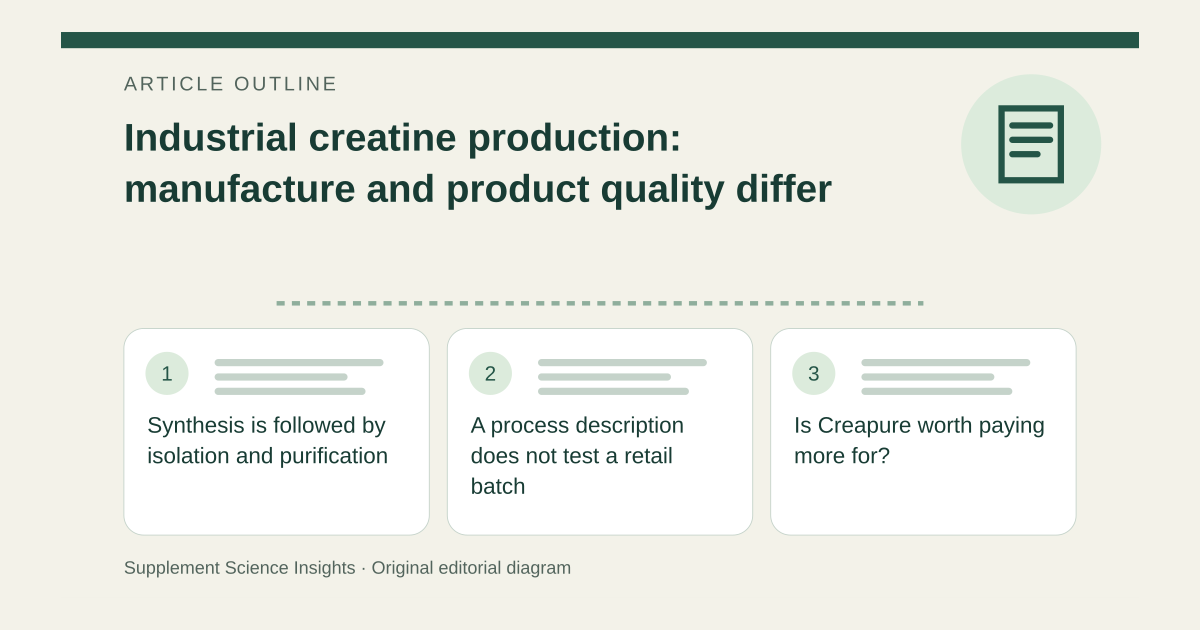
Synthesis is followed by isolation and purification
The cited review describes chemical production followed by crystallization, separation, filtration and drying. Creatine monohydrate crystals include water of crystallization as part of that chemical form. [1]
This is a high-level account, not a home-manufacturing recipe. The starting materials and process controls matter to the identity and impurities of a finished ingredient. [1]
A process description does not test a retail batch
The review contains industry-linked authors and discusses particular manufacturing processes. Its descriptions should not be turned into blanket purity rankings by country or assurances about every brand. [1]
A finished product needs its own identity and quality evidence. The words synthesized or natural alone cannot establish contaminants, declared content or clinical effectiveness. [1]
The intended molecule is not the complete quality record
Imagine two manufacturers target creatine monohydrate. Shared chemical identity does not prove that their finished batches have identical impurity profiles or verified contents.
| Detail | Interpretation |
|---|---|
| Synthesis | Makes the intended compound |
| Purification | Addresses process-related material |
| Retail batch | Needs its own evidence |
Sources for this article
- Common questions and misconceptions about creatine supplementation: what does the scientific evidence really show? | Journal of the International Society of Sports Nutrition | Springer Nature Link
Source consulted: 2026-09-18. This is a reference resource, not a claim that we conducted the studies or tested a product. - Alzchem: Creapure quality seal and licensee code tracking
Source consulted: 2026-09-25. This is a reference resource, not a claim that we conducted the studies or tested a product. - NIH ODS: exercise and athletic performance, protein and creatine
Source consulted: 2026-09-25. This is a reference resource, not a claim that we conducted the studies or tested a product.