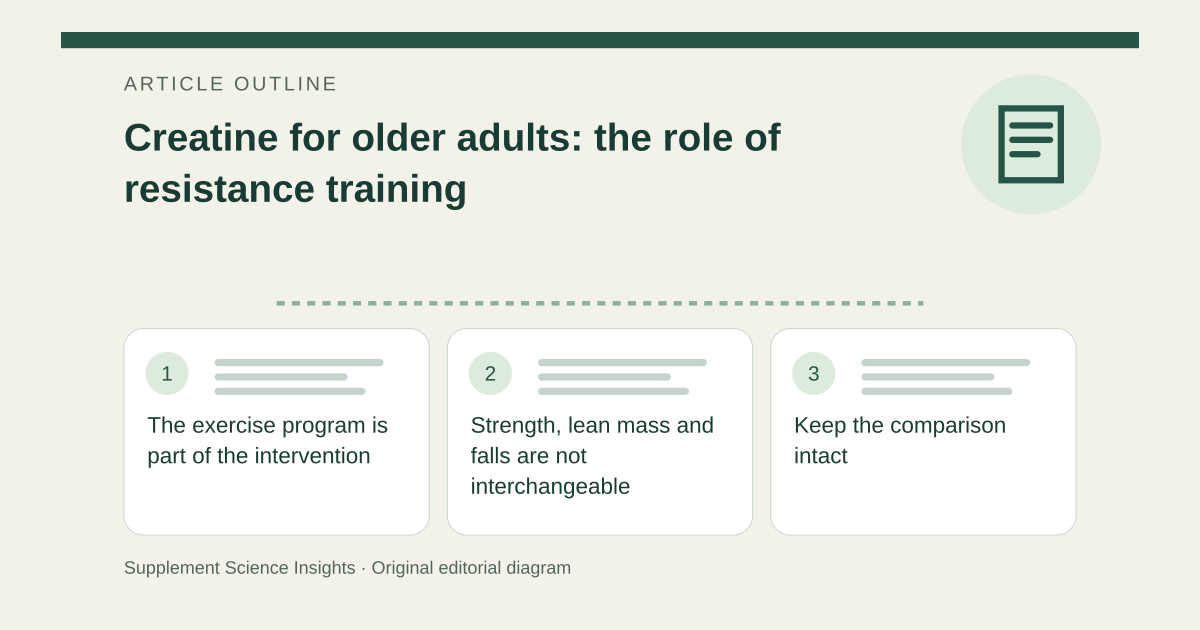
The exercise program is part of the intervention
The 2021 review describes evidence that creatine can augment responses to resistance training in older adults. It also reports that supplementation alone has generally not produced substantial improvements in strength or functional performance. [1]
These are different interventions. Results from creatine plus supervised training should not be presented as the expected result of taking creatine while remaining inactive. [1]
Strength, lean mass and falls are not interchangeable
Research can measure strength, lean tissue, physical tasks, bone density or fractures. Improvement in one does not establish improvement in all of them. [1]
The review describes mixed bone findings and calls for larger, longer studies in frail populations. It does not justify promising that supplementation will prevent an individual’s falls, reverse frailty or treat a diagnosed muscle-wasting condition. [1]
Keep the comparison intact
Imagine a study compares two groups doing the same resistance program, with only one receiving creatine. An additional improvement would address creatine’s contribution within that program.
It would not show that the supplement can replace the program, or that an adult unable to perform the studied exercises will obtain the same result.
| Observation | Interpretation |
|---|---|
| Supplement plus resistance training | The combined intervention |
| A strength-test improvement | Not automatically fewer fractures |
| Different health limitations | Applicability needs assessment |
Age alone does not define an appropriate regimen
The healthy-adult safety discussion in ODS is not a personalized clearance for an older person with kidney disease, complex medication use or frailty. Those factors require individual assessment. [2][1]
This page uses a dated review, not a new systematic review. Its funding statement says not applicable, while several authors disclose industry relationships; the underlying trials were not independently reappraised here. [2][1]
Sources for this article
- Antonio et al. (2021): Common questions and misconceptions about creatine supplementation
Source consulted: 2026-09-17. This is a reference resource, not a claim that we conducted the studies or tested a product. - NIH ODS: Dietary Supplements for Exercise and Athletic Performance
Source consulted: 2026-09-17. This is a reference resource, not a claim that we conducted the studies or tested a product.