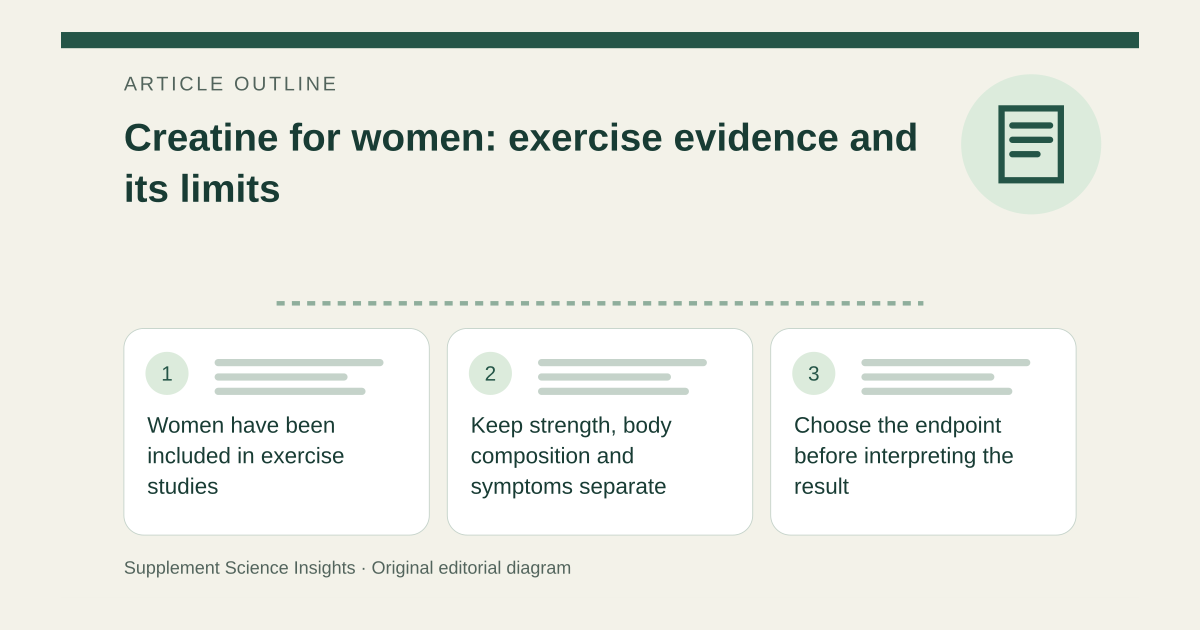
Women have been included in exercise studies
ODS describes benefits in strength and repeated high-intensity activity in studies including women. The energy system supported by creatine is not exclusive to men. [1][2]
The 2021 review describes female exercise studies with both positive and null findings. Sex alone does not predict the size of an individual response, and a benefit for one performance test is not a guarantee across every activity. [1][2]
Keep strength, body composition and symptoms separate
ODS describes a female soccer study in which strength improved more with creatine, but lean tissue did not. That example illustrates why a measured performance benefit should not be relabeled as a demonstrated body-composition change. [1][2]
This is a government summary of a trial, not an independent reanalysis. Claims about mood, hormonal conditions or pregnancy require their own evidence and should not be borrowed from sports-performance findings. [1][2]
Choose the endpoint before interpreting the result
Imagine someone wants better repeated sprint performance, while another person wants treatment for persistent low mood. Evidence addressing the first goal cannot be assumed to answer the second.
A useful reading note states the participants, activity, comparison and measured outcome rather than recording only that creatine helped women.
| Observation | Interpretation |
|---|---|
| Strength was measured | Discuss strength |
| Mood treatment is the goal | Needs separate clinical evidence |
| Pregnancy is relevant | Healthy exercise evidence is insufficient |
Pregnancy is a separate evidence question
The 2021 review discusses preclinical pregnancy research. Animal findings are not a personal recommendation for a pregnant or breastfeeding person, and this page does not establish safety in those settings. [1][2]
The review also discloses industry relationships among several authors. Its discussion is used as a dated synthesis, not proof of a universal women-specific dose or need. [1][2]
Sources for this article
- NIH ODS: Dietary Supplements for Exercise and Athletic Performance
Source consulted: 2026-09-17. This is a reference resource, not a claim that we conducted the studies or tested a product. - Antonio et al. (2021): Common questions and misconceptions about creatine supplementation
Source consulted: 2026-09-17. This is a reference resource, not a claim that we conducted the studies or tested a product.