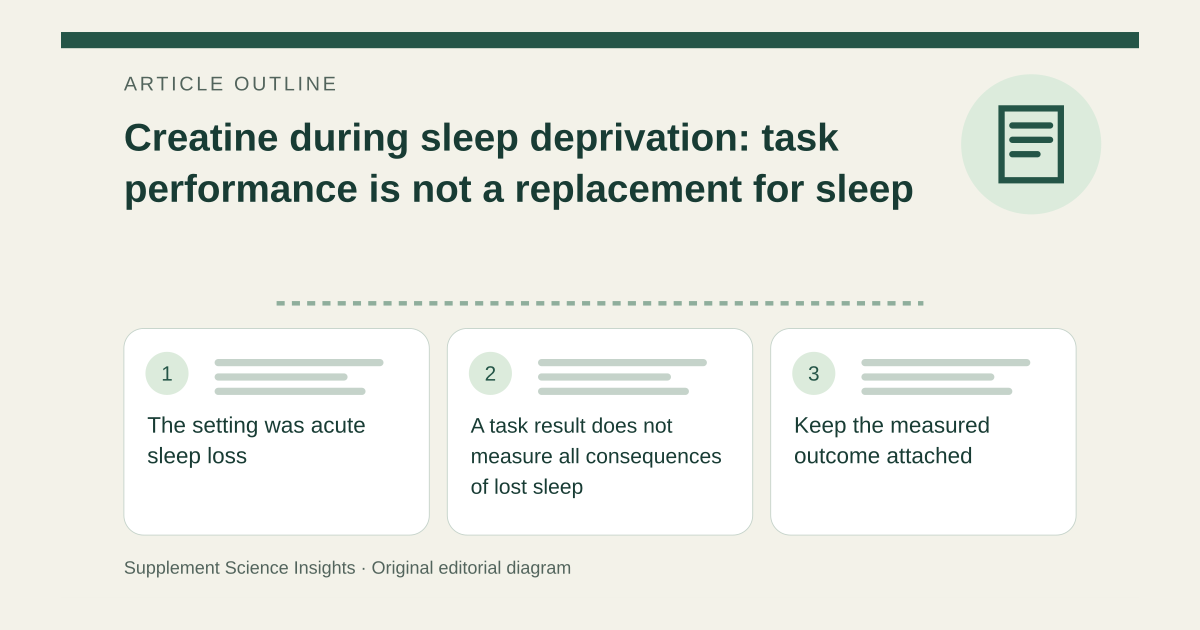
The setting was acute sleep loss
Twenty-nine healthy participants underwent cognitive testing during 21 hours of sleep deprivation. They received a single dose of creatine monohydrate or placebo and were tested at several later time points. [1]
The investigators reported less deterioration in logical and numerical tasks, language processing speed and a vigilance test with creatine. The weight-based experimental dose was not a routine sleep recommendation. [1]
A task result does not measure all consequences of lost sleep
The experiment focused on cognitive performance. It did not show that creatine restores normal sleep physiology, prevents the health effects of repeated sleep loss or makes driving while sleep-deprived safe. [1]
The small sample and brief exposure limit generalization. One author disclosed several research, advisory, stock and patent relationships; others reported no conflicts. Funding was not established from the abstract. Treat the result as a narrow experimental finding, not a reason to reduce sleep. [1]
Keep the measured outcome attached
Imagine a participant answers a logic test faster after lost sleep. That result does not establish that every ability or physiological function has returned to a rested state.
| Detail | Interpretation |
|---|---|
| 21-hour experimental setting | Acute sleep loss |
| Task performance | Measured outcome |
| Normal sleep need | Not tested |
Sources for this article
- Single-Dose Creatine Reduces Sleep Deprivation-Induced Deterioration in Cognitive Performance - PubMed
Source consulted: 2026-09-19. This is a reference resource, not a claim that we conducted the studies or tested a product.