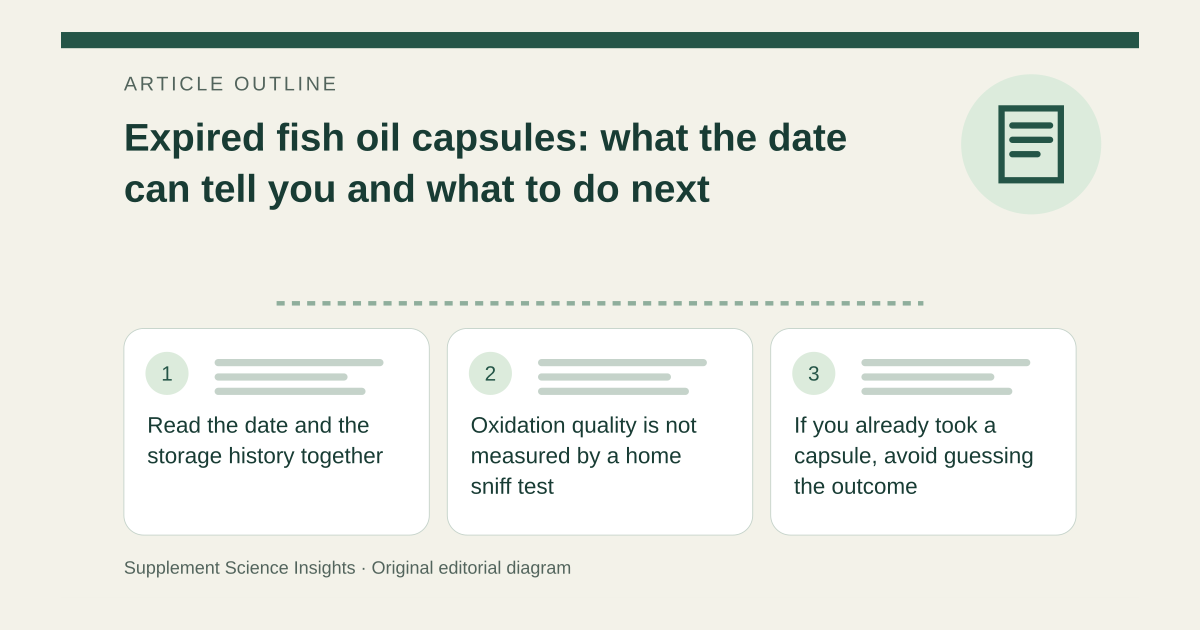
Read the date and the storage history together
FDA says a supplement expiration date, when used, should have supporting data. That does not supply a general number of extra months for continued use. Confirm whether a code means manufacture or expiry, and note heat exposure, damaged packaging or unclear storage when contacting the manufacturer. [1]
Oxidation quality is not measured by a home sniff test
The Codex fish-oil standard uses defined quality measures, including oxidation-related tests. A pleasant smell does not reproduce them, and a poor-quality result would still not predict exactly what symptoms an individual will experience. Do not taste a suspect capsule to test it. [2]
If you already took a capsule, avoid guessing the outcome
The date alone cannot establish that illness will occur or that the product was harmless. Record the product, lot, amount and symptoms, if any. Ordinary omega-3 products can cause gastrointestinal effects too, so symptoms do not identify oxidation by themselves. Contact a clinician or poison center for concerning symptoms or an uncertain ingestion; do not induce vomiting. [3][4]
Replace uncertain stock rather than compensating with more
Do not increase servings to offset an assumed decline in potency. Ask the manufacturer about the exact lot and follow local disposal guidance for unwanted products. If fish oil is part of a clinician-directed plan, discuss a suitable replacement rather than assuming the old bottle still provides dependable contents. [1][5]
Keep the questions separate
Imagine an old bottle was stored in a hot car but the capsules look normal. Its printed date, visual appearance and heat exposure are different pieces of information; none alone validates continued use. Preserve the label details for advice and avoid another serving as a safety experiment. [1][2]
| Information | What it helps establish |
|---|---|
| Date and lot | Manufacturer-specific stability question |
| Heat or damaged package | Storage uncertainty |
| Amount and symptoms | Useful details for clinical or poison advice |
Sources for this article
- Dietary Supplement Labeling Guide: Chapter I. General Dietary Supplement Labeling | FDA
Source consulted: 2026-09-21. This is a reference resource, not a claim that we conducted the studies or tested a product. - Codex Standard for Fish Oils — CXS 329-2017 (amended 2024)
Source consulted: 2026-09-21. This is a reference resource, not a claim that we conducted the studies or tested a product. - Omega-3 Fatty Acids - Health Professional Fact Sheet
Source consulted: 2026-09-21. This is a reference resource, not a claim that we conducted the studies or tested a product. - Poison Control: First aid guidelines
Source consulted: 2026-09-21. This is a reference resource, not a claim that we conducted the studies or tested a product. - Dietary Supplements: What You Need to Know
Source consulted: 2026-09-21. This is a reference resource, not a claim that we conducted the studies or tested a product.