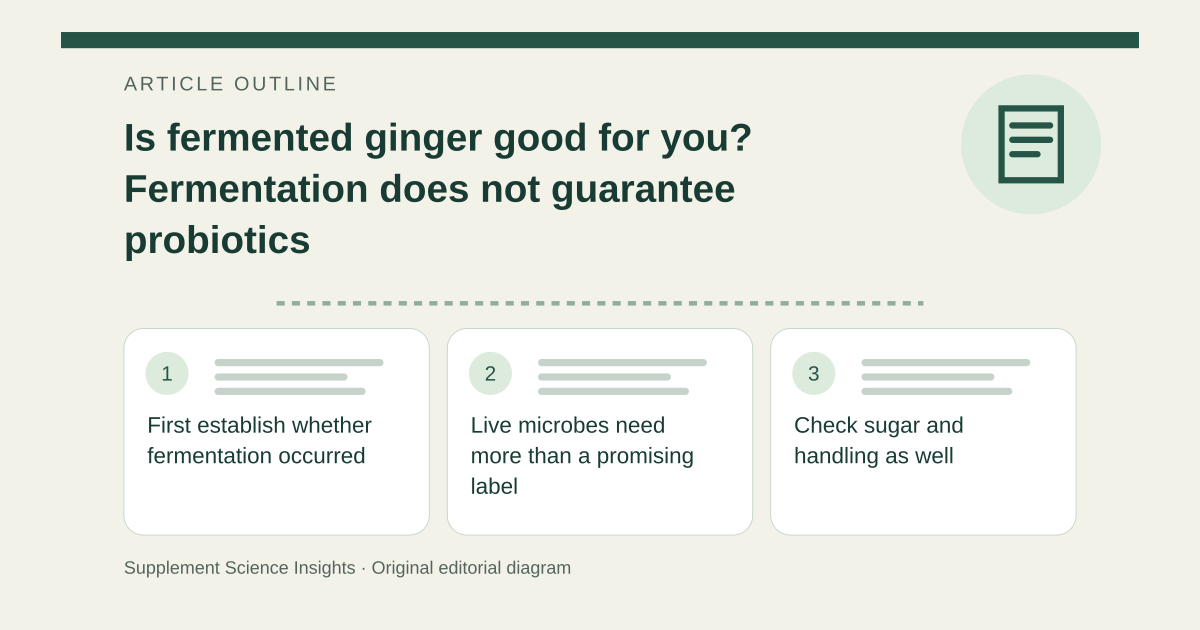
First establish whether fermentation occurred
The ISAPP consensus distinguishes foods transformed through microbial activity from foods simply acidified with vinegar. A sour ginger pickle is not necessarily fermented. The consensus defines terminology; it is not a clinical trial showing benefits of every fermented ginger recipe. [1][2]
Live microbes need more than a promising label
NIH explains that probiotic effects depend on the organisms and supporting evidence. A fermented product may be heated or otherwise processed, and the name alone does not establish live strains, an effective amount or a health benefit. Do not transfer a yogurt or probiotic-capsule result to a ginger drink. [3][1]
Check sugar and handling as well
Fermentation does not allow the remaining sugar content of an unknown recipe to be inferred. Use the finished product’s nutrition information when available. For home preparation, use tested instructions and suitable hygiene rather than assuming bubbling or sourness proves safety. [4][5]
Enjoyment and evidence can be assessed separately
Imagine liking a commercial fermented ginger drink but finding no identified probiotic strain or benefit evidence. It can still be a food preference. The defensible conclusion is that its probiotic claim remains unverified, not that the taste proves a therapeutic effect. [3][1]
| Question | Evidence needed |
|---|---|
| Actually fermented? | Process information |
| Probiotic benefit? | Identified organisms and relevant evidence |
| Sugar content? | Finished-product data |
Sources for this article
- The International Scientific Association for Probiotics and Prebiotics (ISAPP) consensus statement on fermented foods | Nature Reviews Gastroenterology & Hepatology
Source consulted: 2026-09-21. This is a reference resource, not a claim that we conducted the studies or tested a product. - Quick Tsukemono | Kikkoman Corporation
Source consulted: 2026-09-21. This is a reference resource, not a claim that we conducted the studies or tested a product. - Probiotics - Health Professional Fact Sheet
Source consulted: 2026-09-21. This is a reference resource, not a claim that we conducted the studies or tested a product. - How to Understand and Use the Nutrition Facts Label | FDA
Source consulted: 2026-09-21. This is a reference resource, not a claim that we conducted the studies or tested a product. - Fermented Foods Safety Guidance
Source consulted: 2026-09-21. This is a reference resource, not a claim that we conducted the studies or tested a product.