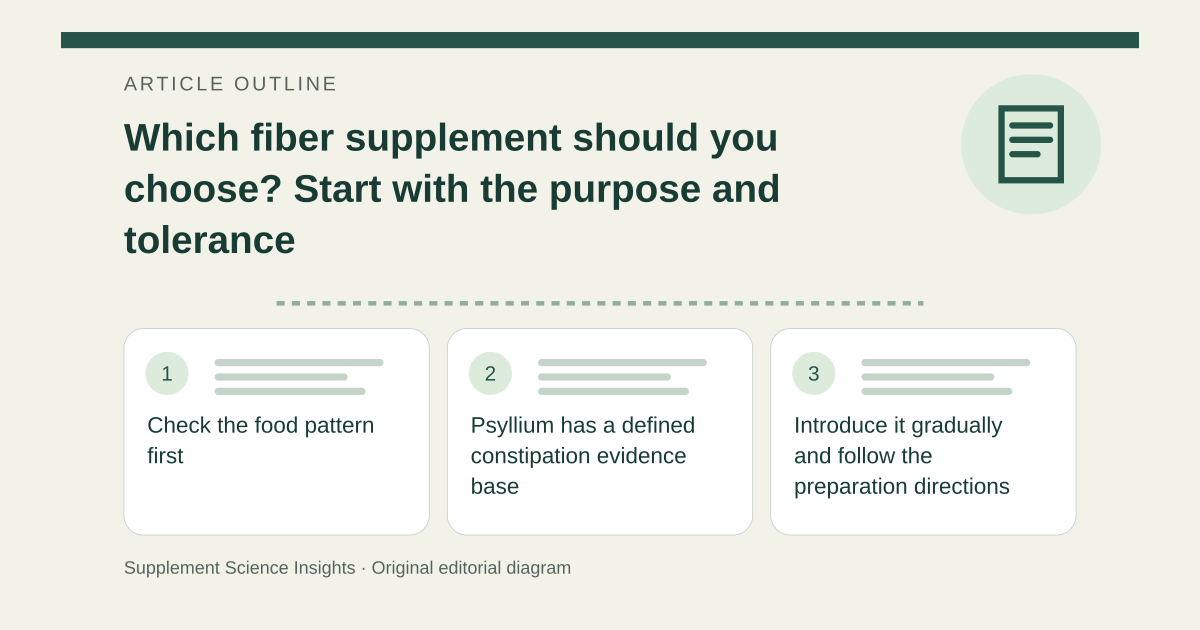
Check the food pattern first
Whole grains, vegetables, fruit, nuts and seeds provide dietary fiber. Review usual intake and the intended outcome before choosing a product. Soluble and insoluble fibers have useful roles, but the category name alone does not identify the best preparation for every symptom. [1]
Psyllium has a defined constipation evidence base
The AGA/ACG guideline conditionally suggests fiber for adults with chronic idiopathic constipation, with low certainty of evidence. Among the evaluated supplements, psyllium appeared effective; evidence for bran and inulin was limited and uncertain. This is a condition-specific recommendation, not proof that one fiber is best for every digestive concern. [2]
Introduce it gradually and follow the preparation directions
Rapid increases can cause gas, bloating and cramps. The guideline encourages adequate hydration with fiber. Follow the exact product instructions and review suitability if symptoms or medical conditions make use uncertain; dry powder and prepared servings should not be treated as interchangeable. [1][2]
Prebiotic is a separate claim
A prebiotic is defined by selective use by host microorganisms with a health benefit. Not every fiber qualifies merely because it reaches the bowel. A product promoted for microbiome effects still needs evidence for the claimed benefit and a preparation the person tolerates. [3]
Psyllium versus glucomannan for fullness
Both are fiber preparations, but their evidence should not be reduced to which absorbs more water. Short, placebo-controlled psyllium crossover trials reported greater fullness between meals; those studies did not compare psyllium directly with glucomannan or establish durable weight loss. Two authors had Procter & Gamble affiliations, and the inspected abstract does not supply a complete funding appraisal. [4][5][6]
NIH ODS summarizes glucomannan as having little to no effect on weight loss. That differs from measuring fullness after a meal. The reviewed sources therefore do not establish a head-to-head fullness winner. For either product, follow its fluid and preparation instructions, review swallowing difficulty and medicine timing, and treat bloating or worsening symptoms as reasons to reassess rather than take more. [4][5][6]
Evaluate one change at a time
Imagine someone with low fiber intake adds a powder and immediately doubles the serving after one day. More is not automatically better. Follow the planned introduction, monitor stool pattern and discomfort, and review persistent symptoms rather than escalating indefinitely. [1][2]
| Goal | Relevant evidence |
|---|---|
| Increase dietary fiber | Food intake and practical serving |
| Chronic idiopathic constipation | Condition-specific fiber evidence |
| Prebiotic benefit | Microorganism use plus demonstrated benefit |
Sources for this article
- Dietary Fiber: MedlinePlus
Source consulted: 2026-09-20. This is a reference resource, not a claim that we conducted the studies or tested a product. - American Gastroenterological Association-American College of Gastroenterology Clinical Practice Guideline: Pharmacological Management of Chronic Idiopathic Constipation - PMC
Source consulted: 2026-09-20. This is a reference resource, not a claim that we conducted the studies or tested a product. - What is a prebiotic? - International Scientific Association for Probiotics and Prebiotics (ISAPP)
Source consulted: 2026-09-20. This is a reference resource, not a claim that we conducted the studies or tested a product. - Brum et al. 2016: Satiety effects of psyllium in healthy volunteers
Source consulted: 2026-09-25. This is a reference resource, not a claim that we conducted the studies or tested a product. - NIH ODS: Dietary supplements for weight loss, consumer fact sheet
Source consulted: 2026-09-25. This is a reference resource, not a claim that we conducted the studies or tested a product. - MedlinePlus: Psyllium
Source consulted: 2026-09-25. This is a reference resource, not a claim that we conducted the studies or tested a product.