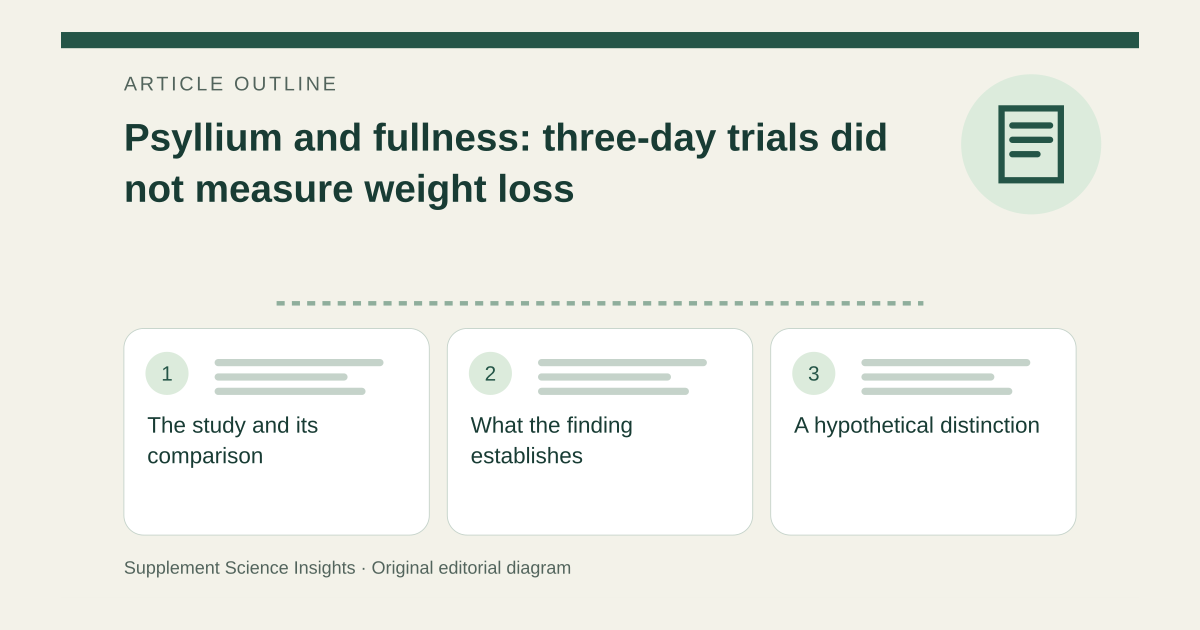
The study and its comparison
Two placebo-controlled crossover studies tested psyllium before meals over three-day periods. Researchers used ratings of hunger, desire to eat and fullness rather than sustained body-weight change. [1]
The studied regimens produced favorable satiety ratings, with some amounts giving more consistent effects. Mild gastrointestinal adverse events were broadly similar between active and placebo conditions. [1]
What the finding establishes
A feeling of fullness is not proof of lower long-term energy intake or weight loss. The report tested a named psyllium preparation, not ColonBroom. Two authors were affiliated with Procter & Gamble; the retrieved abstract did not establish all funding details or sample sizes. [1]
A hypothetical distinction
Imagine a person rates hunger lower for three days. A claim about kilograms lost over months still requires another endpoint.
| Detail | Interpretation |
|---|---|
| Measured outcome | Keep the endpoint specific |
| Study preparation | Not every retail product |
| Remaining uncertainty | Not resolved by a mechanism |
Sources for this article
- Satiety effects of psyllium in healthy volunteers.
Source consulted: 2026-09-19. This is a reference resource, not a claim that we conducted the studies or tested a product.