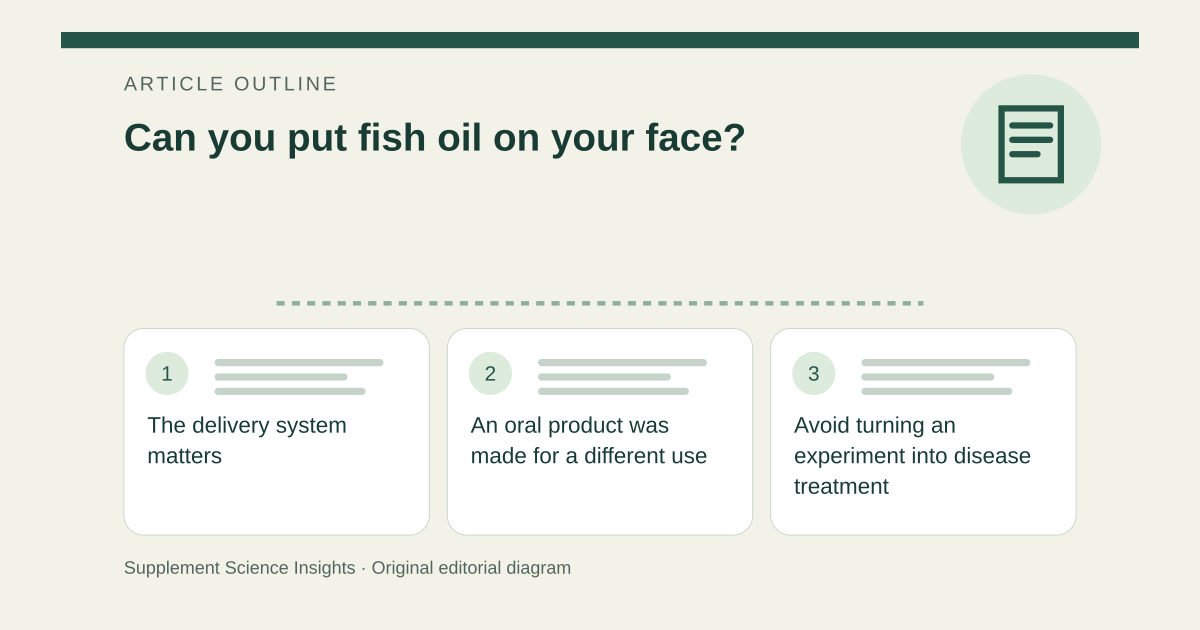
The delivery system matters
A 2025 topical review found promising research, including skin-model findings, but no consensus on the best molecule, amount or delivery method. The authors called for more clinical studies. Those findings do not validate a homemade facial regimen. [1]
An oral product was made for a different use
Its capsule ingredients, storage and formulation are not evidence of suitability for facial application. The absence of reported irritation in a research setting cannot guarantee that an unrelated oral oil will be well tolerated on someone’s skin. [1][2]
Avoid turning an experiment into disease treatment
Do not substitute capsule oil for prescribed treatment of acne, eczema or an infected lesion. AAD advises stopping skin products that irritate; its guidance for testing finished cosmetics is not an endorsement of every homemade mixture. [3]
Choose a preparation with a clear purpose
Imagine a topical study used a defined formulation but a social-media recipe uses an unspecified fish oil. They are not equivalent interventions. Use a product intended for the skin and discuss the actual concern if ordinary care is not helping. [1][3]
| Question | Evidence boundary |
|---|---|
| Oral capsule | Not a tested facial formula |
| Skin-model result | Not a home-use guarantee |
| Burning or rash | Stop and assess |
| Persistent skin problem | Appropriate care |
Sources for this article
- Therapeutic Benefits of Topical Omega-3 Polyunsaturated Fatty Acids in Skin Diseases and Cosmetics: An Updated Systematic Review.
Source consulted: 2026-09-21. This is a reference resource, not a claim that we conducted the studies or tested a product. - Dietary Supplements: What You Need to Know
Source consulted: 2026-09-21. This is a reference resource, not a claim that we conducted the studies or tested a product. - How to test skin care products
Source consulted: 2026-09-21. This is a reference resource, not a claim that we conducted the studies or tested a product.