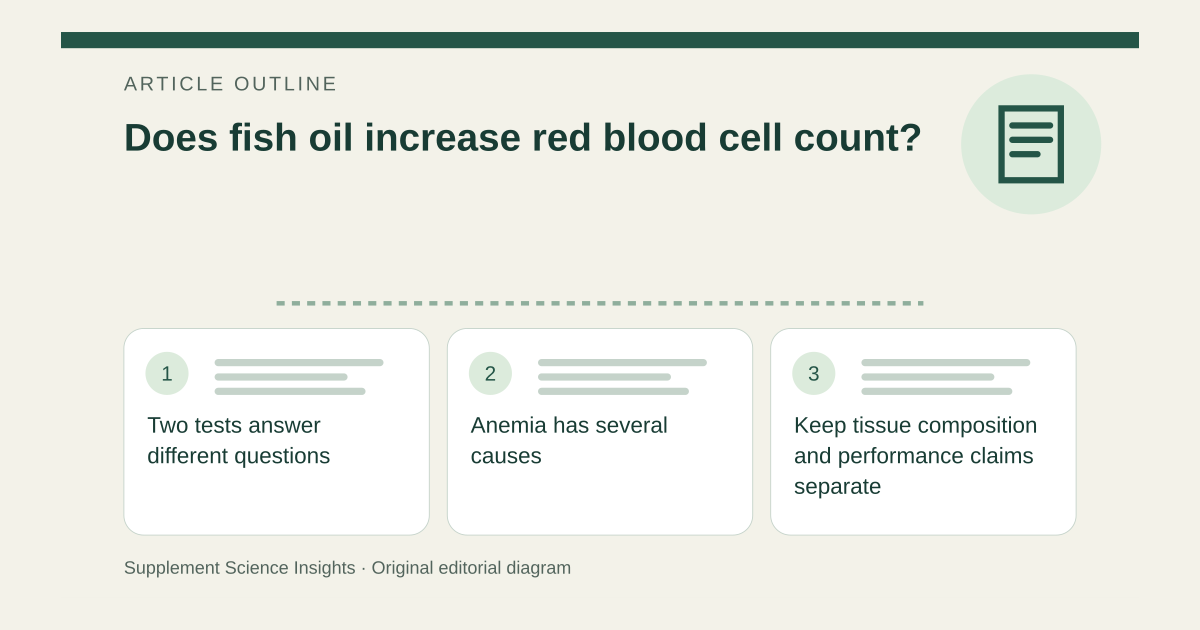
Two tests answer different questions
ODS describes an omega-3 index based on EPA and DHA in erythrocyte fatty acids. A complete blood count instead includes red-cell number and related measures such as hemoglobin. Changing the fatty-acid percentage does not demonstrate production of more red cells. [1][2]
Anemia has several causes
Iron, B12 or other replacement may help a corresponding deficiency, while other anemias require different treatment. NHLBI cautions against unnecessary iron. Fish oil cannot be selected simply because a report says a red-cell measure is low. [3]
Keep tissue composition and performance claims separate
A change in a blood fatty-acid biomarker does not by itself prove improved oxygen delivery, endurance or correction of fatigue. Those outcomes need their own clinical evidence and assessment. [1][2]
Bring the actual reports to the review
Imagine an omega-3 test improves while hemoglobin remains low. These findings can coexist because they measure different things. Continue the anemia evaluation rather than treating the index change as evidence that the problem is resolved. [2][3]
| Claim or observation | Interpretation |
|---|---|
| Omega-3 index | Fatty-acid composition |
| Red-cell count | Number of cells |
| Hemoglobin | Different blood measurement |
| Low result | Cause-specific assessment |
Sources for this article
- Omega-3 Fatty Acids - Health Professional Fact Sheet
Source consulted: 2026-09-21. This is a reference resource, not a claim that we conducted the studies or tested a product. - Complete Blood Count (CBC): MedlinePlus Medical Test
Source consulted: 2026-09-21. This is a reference resource, not a claim that we conducted the studies or tested a product. - Anemia - Treatment and Management | NHLBI, NIH
Source consulted: 2026-09-21. This is a reference resource, not a claim that we conducted the studies or tested a product.