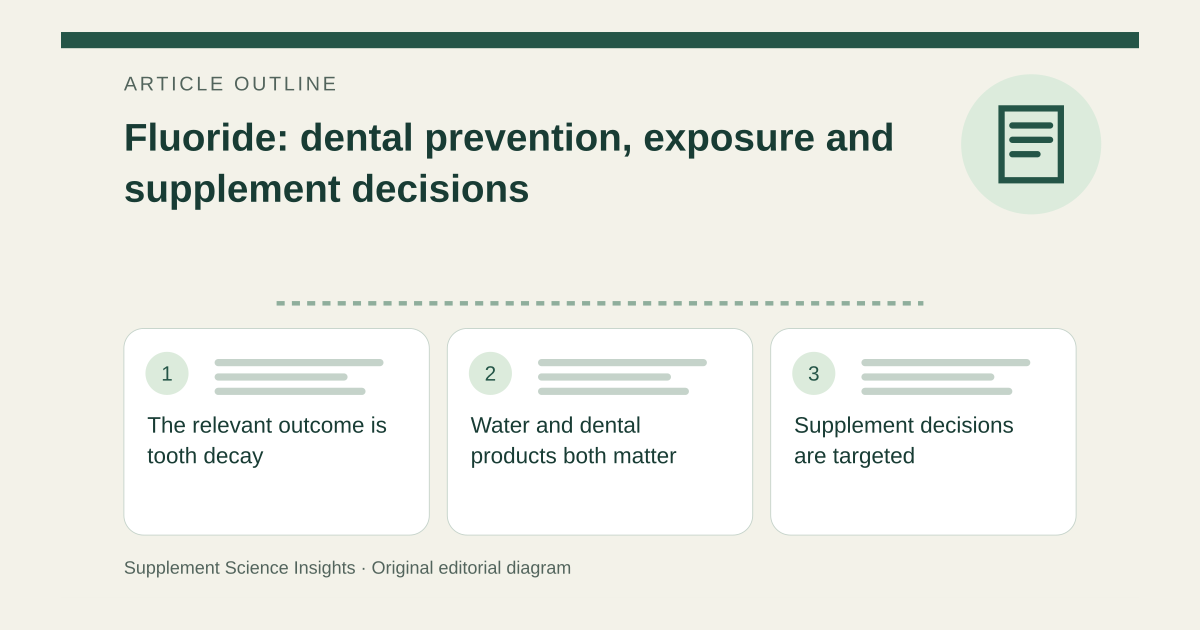
The relevant outcome is tooth decay
Fluoride helps protect tooth enamel against decay. It is encountered in drinking water, foods and beverages made with that water, and dental products. A fluoride toothpaste and a swallowed supplement have different uses and should not be compared as if they were interchangeable capsules. [1]
This page addresses how to understand those distinctions. It does not provide a pediatric prescription, change a community water policy or suggest swallowing toothpaste. The form, route and total exposure are central to the question. [1]
Water and dental products both matter
Fluoridated water can be a major source of ingested fluoride. Bottled water varies, and a household filter does not automatically establish whether fluoride has been removed. Dental products generally act in the mouth and should be used according to their directions. [2]
Before considering a child's supplement, the dentist or pediatric clinician needs the child's age, cavity risk and actual water sources. “We drink tap water” is not a concentration measurement; a utility report or appropriate water testing supplies more useful information. [2]
Supplement decisions are targeted
Fluoride supplements have been used to reduce caries in children whose water has insufficient fluoride. Evidence and recommendations depend on age, exposure and risk. Nutritional intake reference values should not be converted into a self-prescribed supplement dose. [1]
A dental professional can distinguish supplemental fluoride from topical varnish or toothpaste advice. A product's milligram amount alone does not tell you which preventive approach is appropriate, and evidence from children should not be generalized into an adult bone-health recommendation. [1]
Too much during tooth development can leave marks
Excess fluoride while teeth are developing can cause dental fluorosis. Very large ingestions of fluoride products can cause acute toxicity, while prolonged excessive exposure can affect bones. These are different exposure patterns; a discussion of one should not silently stand in for all others. [2]
Keep dental products and supplements out of children's reach and follow the care team's directions. A suspected substantial ingestion needs prompt poison-control or medical advice, not a calculation from an online nutrient table. [2]
A water calculation is only one part of exposure
Suppose a fictional water report lists 0.5 mg fluoride per liter. Drinking 0.8 liters of that water would contribute 0.4 mg: 0.5 multiplied by 0.8. This arithmetic describes that water contribution only.
It excludes other drinks, food prepared with water and swallowed dental-product residue. It cannot determine whether a child needs a prescription. If the water concentration is unknown, write “unknown” instead of choosing a typical community value or assuming that all bottled water is fluoride-free.
| Input | Value |
|---|---|
| Water concentration | 0.5 mg/L |
| Water consumed | 0.8 L |
| Contribution from that water | 0.4 mg |
Bring a source record to the dental visit
A useful record lists water sources at home, school or childcare, the toothpaste used and any current fluoride product. That allows the professional to evaluate the full picture and avoids accidentally treating each exposure as if it were the only one.
This overview uses NIH educational summaries. It does not settle all population-level policy questions or independently assess every recent exposure study. Its practical purpose is to make a personal dental discussion more accurate, without turning nutritional numbers into a dosing schedule.
Sources for this article
- NIH ODS — Fluoride, professional fact sheet
Source consulted: 2026-09-17. This is a reference resource, not a claim that we conducted the studies or tested a product. - NIH ODS — Fluoride, consumer fact sheet
Source consulted: 2026-09-17. This is a reference resource, not a claim that we conducted the studies or tested a product.