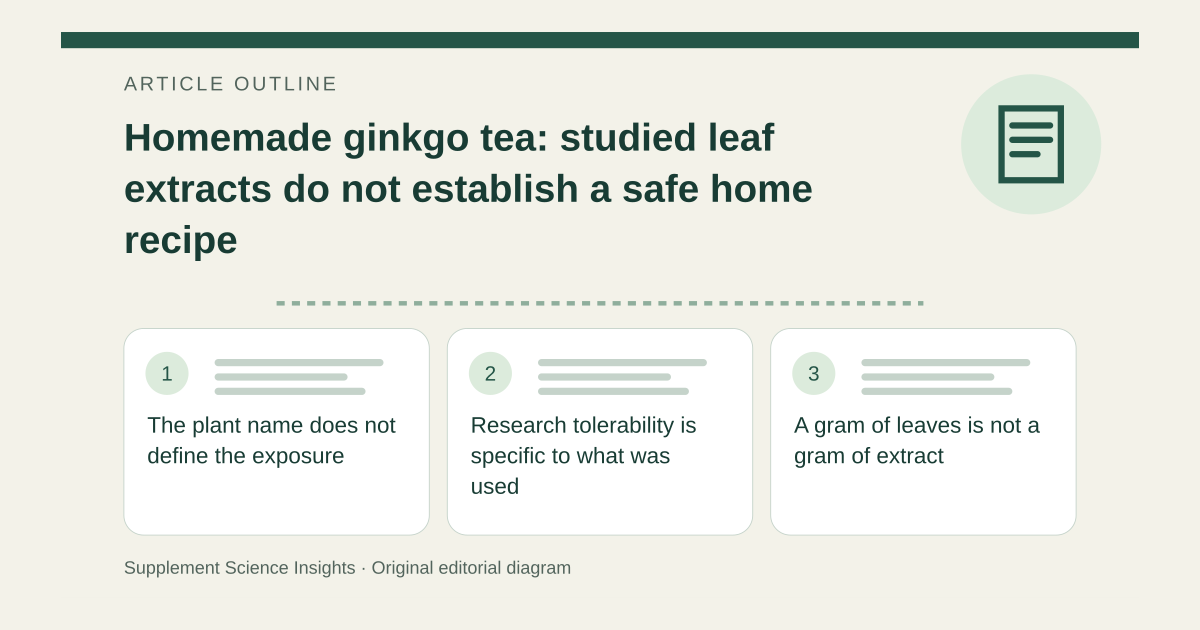
The plant name does not define the exposure
NCCIH distinguishes commonly studied ginkgo leaf extracts from other plant material. Fresh seeds are toxic when eaten, and serious adverse effects have also occurred after roasted seeds or crude ginkgo plant material. A kitchen preparation should not be assumed equivalent to a defined extract. [1]
Knowing that a leaf comes from a ginkgo tree does not establish the composition of the resulting infusion. Drying time, water volume or taste cannot supply a validated measure of relevant constituents or contaminants. [1]
Research tolerability is specific to what was used
Some leaf extracts have been used in studies lasting years, but that does not transfer their safety record to a homemade tea. It also does not establish that a product is suitable during pregnancy, with anticoagulants or alongside other medicines. [1]
This evidence supplies no safe home recipe, seed-detoxification method or conversion from cups of tea to an extract dose. If considering ginkgo, the appropriate review concerns the actual preparation and reason for use, including whether evidence supports the intended benefit. [1]
A gram of leaves is not a gram of extract
Imagine someone replaces a trial’s defined extract with the same mass of dried leaves. Matching mass does not match chemical composition or exposure. The substitution leaves both efficacy and safety unanswered.
| Item | Interpretation |
|---|---|
| Defined trial extract | Specified intervention |
| Home-dried leaves | Different, incompletely characterized material |
| Equal mass | Not equivalent exposure |
Sources for this article
- NCCIH: Ginkgo
Source consulted: 2026-09-17. This is a reference resource, not a claim that we conducted the studies or tested a product.