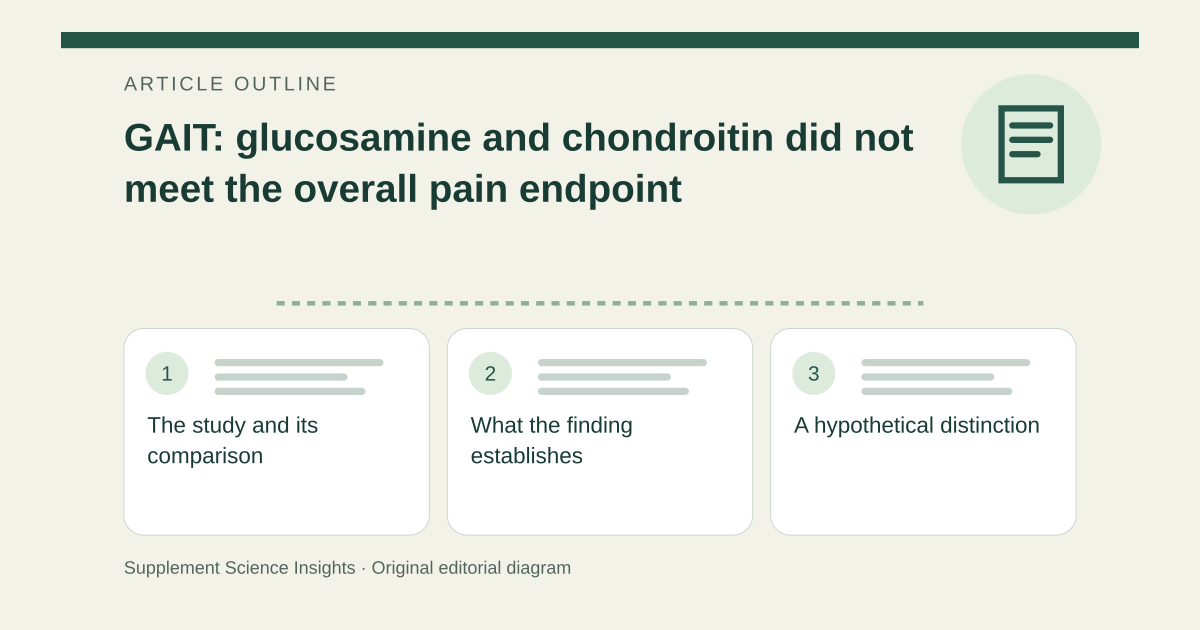
The study and its comparison
GAIT randomized 1,583 people with symptomatic knee osteoarthritis to glucosamine, chondroitin, their combination, celecoxib or placebo for 24 weeks. The primary endpoint was a 20-percent reduction in knee pain. [1]
Neither supplement alone nor the combination significantly outperformed placebo overall. Celecoxib did. An exploratory analysis favored the combination among participants with moderate-to-severe baseline pain. [1]
What the finding establishes
The subgroup finding does not replace the full-population result, and this pain trial does not show cartilage rebuilding. Full funding and conflict details were not established from the retrieved abstract. Different commercial blends should not claim the subgroup as proof of their own effectiveness. [1]
A hypothetical distinction
Imagine a favorable subgroup headline omits the overall null comparison. Reading both changes the strength of the claim.
| Detail | Interpretation |
|---|---|
| Measured outcome | Keep the endpoint specific |
| Study preparation | Not every retail product |
| Remaining uncertainty | Not resolved by a mechanism |
Sources for this article
- Glucosamine, chondroitin sulfate, and the two in combination for painful knee osteoarthritis.
Source consulted: 2026-09-19. This is a reference resource, not a claim that we conducted the studies or tested a product.