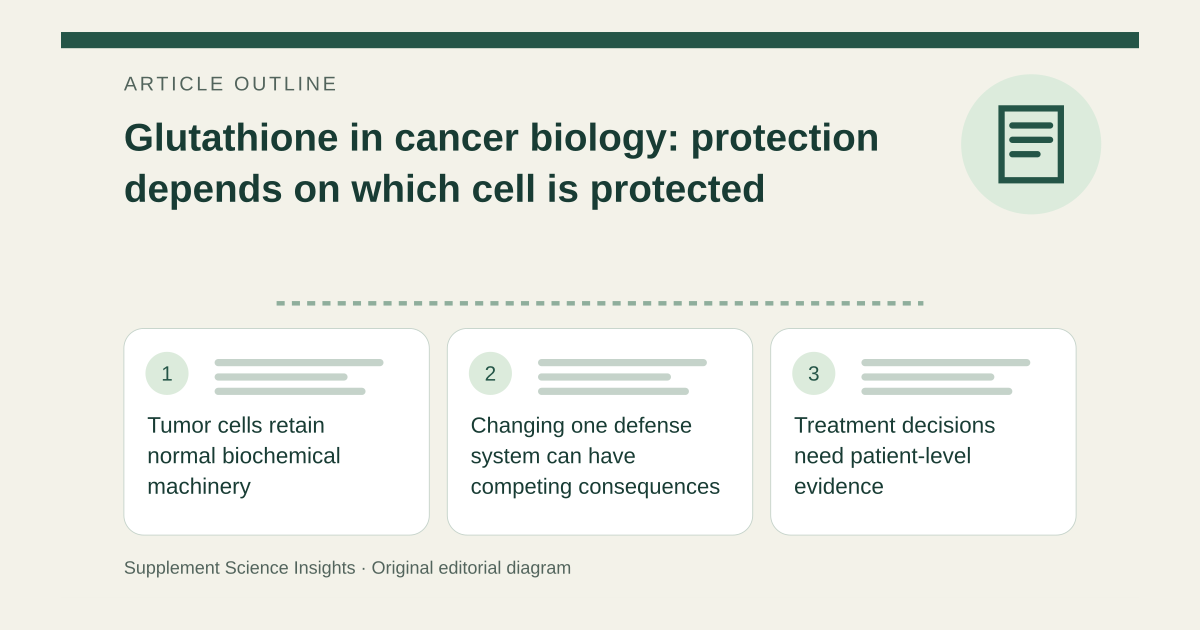
Changing one defense system can have competing consequences
A proposal to protect healthy tissue during treatment and a proposal to make tumor cells more vulnerable can point in different directions. Whether either strategy helps depends on the cancer, treatment, timing and tissue exposure. [1]
Similarly, experimentally depleting glutathione is not a general health strategy. Normal tissues also rely on these systems. A mechanism that appears useful in a cell dish cannot establish a safe balance throughout a person’s body. [1]
Treatment decisions need patient-level evidence
This article uses a mechanistic review, not an independently reappraised clinical trial or a current oncology protocol. It cannot determine whether glutathione or a precursor should be added to a cancer regimen. Discuss antioxidant supplements with the treating oncology team before starting or stopping them. [1]
The useful question is whether a specified intervention improves meaningful outcomes alongside a specified treatment, with acceptable harms. An antioxidant label or a favorable cell marker cannot answer that question alone. [1]
A cell-survival result can point in opposite directions
Imagine a compound helps cells survive a treatment exposure. That could be desirable for a healthy tissue model and undesirable for a tumor model. Without identifying the cells, the same phrase would conceal the central issue.
| Observation | What it means |
|---|---|
| Normal-cell protection | One possible research objective |
| Tumor-cell protection | Potentially different implication |
| Patient benefit | Requires clinical evidence |
Sources for this article
- Lu: Glutathione synthesis — foundational mechanistic review
Source consulted: 2026-09-17. This is a reference resource, not a claim that we conducted the studies or tested a product.