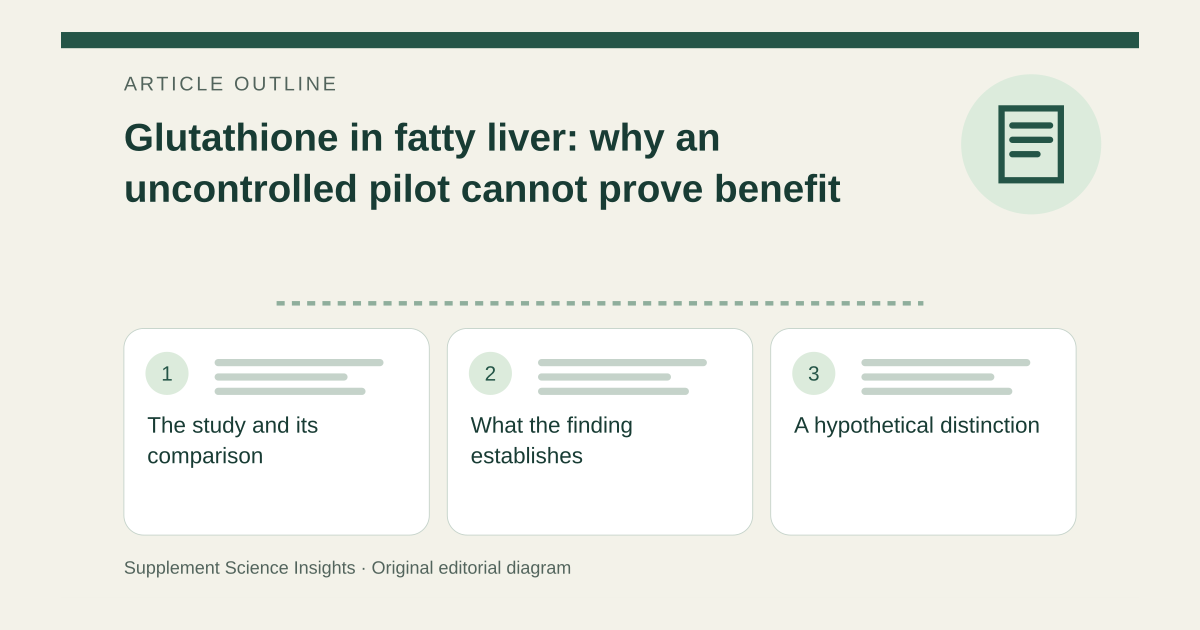
The study and its comparison
Thirty-four people with ultrasound-diagnosed fatty liver entered an open-label pilot. A three-month lifestyle phase preceded four months of oral glutathione. Twenty-nine completed the protocol. [1]
The primary liver-enzyme measure, ALT, fell after supplementation. Several other blood markers also declined. A selected subgroup defined by its ALT response showed a change in a liver-fat assessment. [1]
What the finding establishes
There was no concurrent placebo group to separate treatment from time, lifestyle changes or regression toward usual values. Selecting responders after observing outcomes further limits causal interpretation. The authors declared no competing interests; funding was not established from the abstract. Neither enzyme improvement nor this pilot demonstrates reversal of fibrosis or prevention of liver failure. [1]
A hypothetical distinction
Imagine a biomarker improves after diet changes and then a supplement. Without a concurrent control, assigning the improvement to one step is uncertain.
| Detail | Interpretation |
|---|---|
| Measured outcome | Keep the endpoint specific |
| Study preparation | Not every retail product |
| Remaining uncertainty | Not resolved by a mechanism |
Sources for this article
- Efficacy of glutathione for the treatment of nonalcoholic fatty liver disease: an open-label, single-arm, multicenter, pilot study.
Source consulted: 2026-09-19. This is a reference resource, not a claim that we conducted the studies or tested a product.