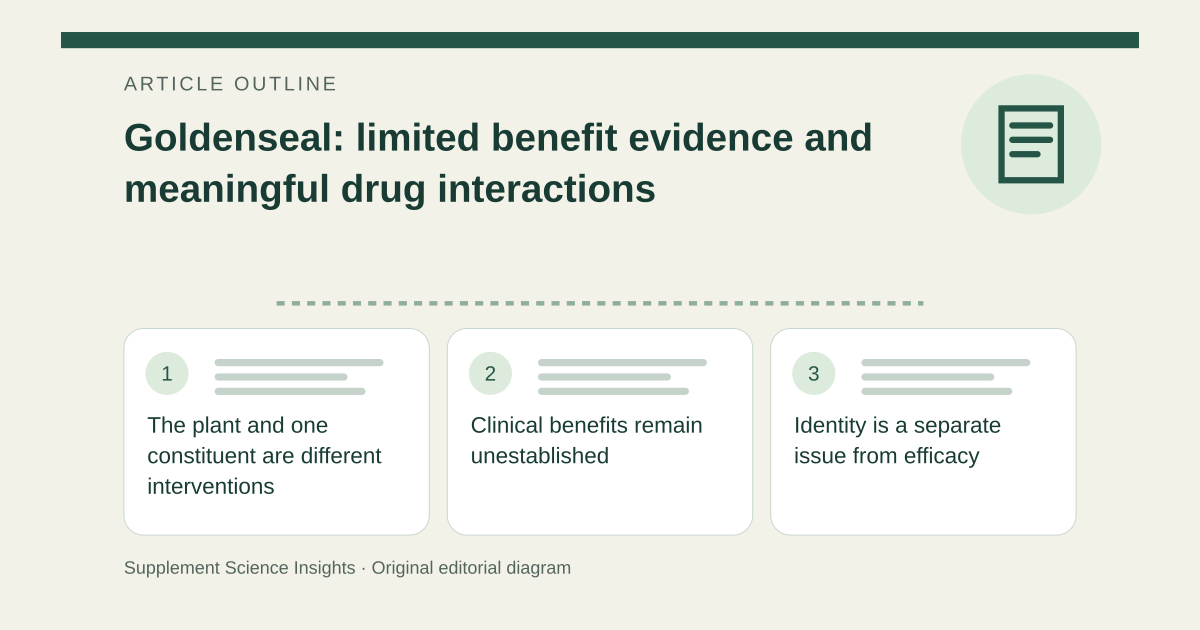
The plant and one constituent are different interventions
Goldenseal, Hydrastis canadensis, contains berberine among other constituents. It is often sold alone or in multi-herb preparations. The presence of a named chemical does not establish that a serving delivers the same exposure as an isolated-ingredient product. [1]
NCCIH notes that little berberine may be absorbed after oral goldenseal. Research using berberine therefore cannot simply be relabeled as goldenseal research. The formulation and exposure are part of the intervention, not incidental details. [1]
Clinical benefits remain unestablished
Rigorous human studies have not established goldenseal's effectiveness for a health condition. Traditional use and laboratory observations can motivate research, but they do not fill that clinical evidence gap. [1]
A claim about infection, digestion or metabolic health should identify the actual human evidence for goldenseal. If its supporting citation instead studies purified berberine or a combination product, that mismatch should remain visible. An ingredient-level mechanism is not proof that a retail botanical treats a disease. [1]
Identity is a separate issue from efficacy
Some commercial goldenseal products have contained undeclared herbs or substituted ingredients. Accurate botanical identity is therefore an important question even before evaluating a health claim. [1]
A quality document needs to refer to the actual product and relevant batch. Confirming identity would not, by itself, prove effectiveness; it would establish that the material being discussed is what the label says. Conversely, a persuasive clinical story cannot compensate for unresolved product identity. A useful identity report names the analytical method and the material sampled. [1]
Medication exposure can change
Goldenseal can alter how the body handles medicines. NCCIH describes research in healthy adults where goldenseal reduced metformin exposure by roughly one quarter, a change that could potentially compromise glucose control in patients. The healthy-volunteer setting and the potential clinical consequence should both remain explicit. [1]
Long-term safety is uncertain even though small short studies did not identify serious harm. Pregnant or breastfeeding people should not use goldenseal, and it should not be given to infants because of concerns about its berberine constituent. [1]
Do not convert plant mass into a constituent dose
Imagine a fictional label lists 500 mg goldenseal root but gives no berberine amount. A second product lists 500 mg berberine. The identical printed mass does not make them equivalent: one number describes plant material and the other a particular constituent.
Without composition and exposure information, no reliable dose conversion follows. This example does not recommend either product or suggest adjusting a prescribed medicine.
| Fictional declaration | What the mass describes |
|---|---|
| 500 mg goldenseal root | Plant material |
| 500 mg berberine | Named constituent |
| Matching milligrams | Not equivalent exposure |
The interaction evidence may matter more than the claim
A lack of established benefit does not imply a lack of biological activity. When considering goldenseal, unresolved efficacy and medication interactions belong in the same discussion. This reference does not endorse it for infection or glucose management.
Sources for this article
- NCCIH — Goldenseal: Usefulness and Safety
Source consulted: 2026-09-17. This is a reference resource, not a claim that we conducted the studies or tested a product.