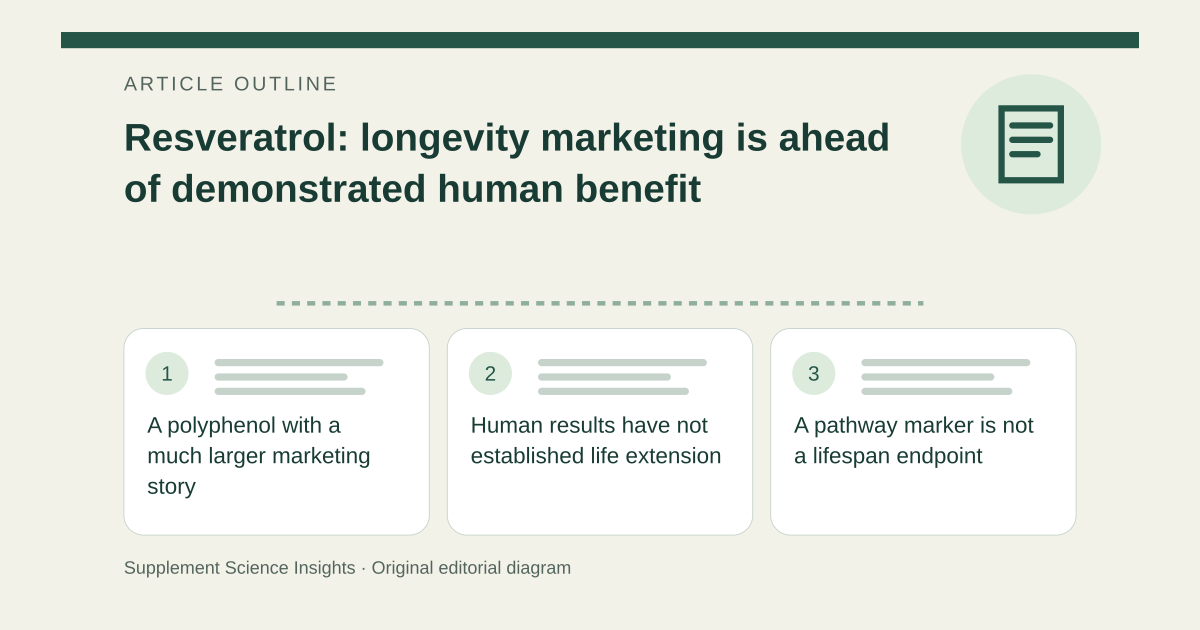
A polyphenol with a much larger marketing story
Resveratrol occurs in several botanical foods and is sold in concentrated supplements. Its association with grapes and red wine does not make those exposures equivalent to a capsule. A study's preparation and amount should remain identifiable. [1]
Longevity marketing often begins with laboratory pathways or lifespan findings in simple organisms. Those observations can motivate research, but they do not directly measure how long people live or how well they function as they age. [1]
Human results have not established life extension
Memorial Sloan Kettering describes mixed or negative findings across several metabolic and cognitive questions. Human life extension has not been demonstrated. A favorable biomarker or small condition-specific study should not be rewritten as a general anti-aging effect. [1]
Cancer-related laboratory results also do not establish a treatment. Evidence from a concentrated preparation in a clinical study cannot be transferred to drinking wine, and this page does not recommend alcohol as a way to obtain resveratrol. [1]
A pathway marker is not a lifespan endpoint
Suppose a study measures a protein associated with cellular stress responses. Even a credible change in that protein does not establish fewer illnesses, preserved independence or longer survival. Each of those outcomes would require an appropriate study design and follow-up.
Check whether a claim uses an animal lifespan result, a human biomarker or an actual clinical endpoint. They are different levels of evidence. Combining them into a single narrative can make a speculative chain sound like a demonstrated result even when its essential links remain untested.
High exposure and drug interactions deserve attention
Higher amounts can cause gastrointestinal effects such as diarrhea. Resveratrol can affect drug-metabolizing enzymes, and possible interactions with antiplatelet treatment require discussion. Its hormone-related activity also matters in treatment contexts. [1]
MSK describes serious adverse events in a high-dose clinical formulation studied in people with multiple myeloma. That does not establish the risk for every supplement, but it rules out assuming that more exposure is harmless. Review use during cancer treatment with the oncology team. [1]
Do not turn a percentage marker change into extra years
Imagine a fictional study reports a 15 percent change in a laboratory marker after eight weeks. It does not show that participants live 15 percent longer, age 15 percent more slowly or gain a calculable number of years.
Those quantities have different denominators and meanings. A claim about lifespan would need actual survival evidence, not a conversion from a biochemical percentage.
| Hypothetical observation | Unsupported conversion |
|---|---|
| 15% biomarker change | 15% longer life |
| Eight-week follow-up | Lifetime benefit |
| Cellular mechanism | Proven clinical outcome |
Keep healthy-aging claims tied to measured outcomes
This reference does not recommend resveratrol for longevity or disease treatment. A useful account can explain scientific interest while acknowledging that a pathway, a biomarker and a clinical benefit are not interchangeable. The formulation and medication context remain part of the assessment.
Sources for this article
- Memorial Sloan Kettering — Resveratrol
Source consulted: 2026-09-17. This is a reference resource, not a claim that we conducted the studies or tested a product.