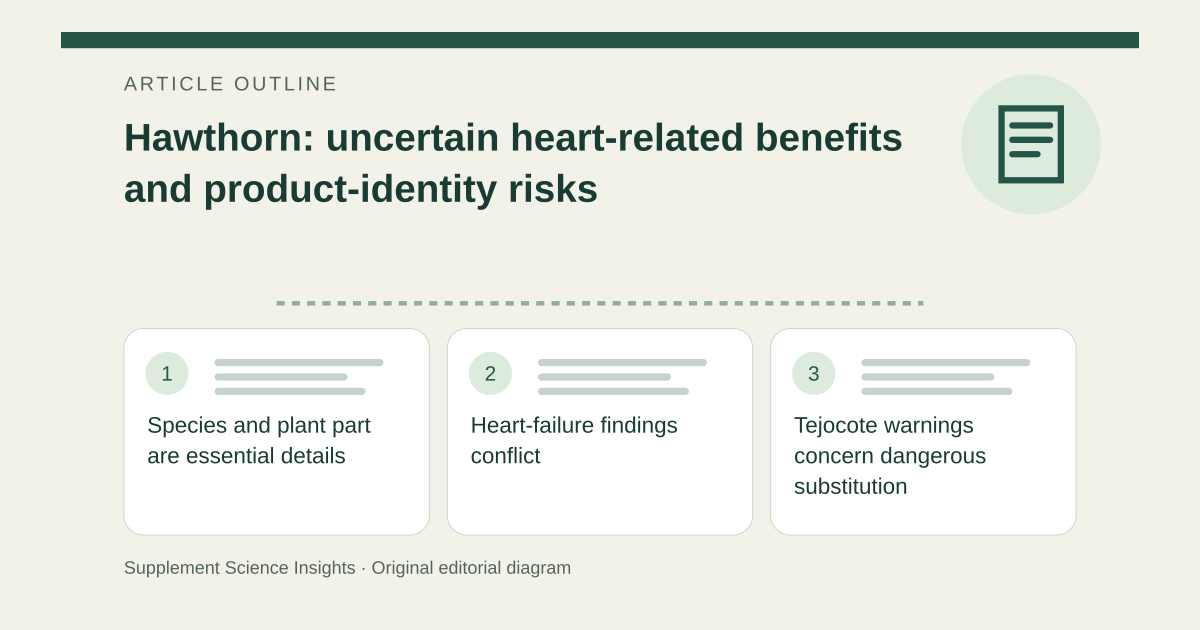
Species and plant part are essential details
Hawthorn refers to plants in the Crataegus genus. Leaves, flowers, fruit and root products should not be treated as a single intervention. A product marketed as tejocote root raises a different identity question from an extract used in a heart-failure study. [1]
Record the species, plant part and preparation before interpreting research. A shared common name is insufficient to establish that a retail supplement matches the material tested in people. [1]
Heart-failure findings conflict
NCCIH describes conflicting evidence in heart failure and insufficient evidence for other cardiovascular claims, including abnormal rhythm, angina and arterial plaque. Evidence does not support a weight-loss claim, and effects on anxiety remain unclear. [1]
A study conducted alongside standard cardiac treatment does not show that hawthorn can replace that treatment. Symptom scores, exercise tests, hospital admissions and survival are different outcomes; a favorable result in one cannot be silently expanded to the others. [1]
Tejocote warnings concern dangerous substitution
NCCIH summarizes FDA warnings about some products labeled tejocote root that actually contained yellow oleander. Yellow oleander is toxic and can cause severe, potentially fatal harm. The issue is product substitution, not a desirable stronger form of hawthorn. [1]
This warning should not be stretched into a claim that every hawthorn product is adulterated. It does mean that label identity cannot simply be assumed for an implicated product category, and appearance or a seller's reassurance cannot independently establish composition. [1]
Cardiac medicines and uncertain long-term safety matter
One study raised concern about earlier heart-failure progression with a particular preparation; an interaction with background medicines was one possible explanation. That finding deserves attention alongside the inconsistent benefit evidence. [1]
Reported adverse effects include dizziness and digestive symptoms. Long-term safety is insufficiently studied, and pregnancy or breastfeeding information is limited. People receiving cardiac care should discuss supplements with their care team rather than adding a product to treat symptoms independently. [1]
Do not combine unlike preparations
Imagine a fictional research summary concerns a standardized leaf-and-flower extract while a store listing offers root powder for weight loss. These differ in plant part, preparation and intended outcome. The study cannot serve as evidence for the store listing merely because both use the name hawthorn.
A comparison table should preserve those mismatches rather than supplying a conversion between their milligram amounts. This example does not identify a safe product or a treatment dose.
| Fictional source | Applicability limit |
|---|---|
| Leaf-and-flower extract trial | Specific researched material |
| Root powder listing | Different plant part |
| Heart-failure versus weight claim | Different clinical question |
Evidence and identity must both be adequate
A plausible heart-health narrative is not enough when clinical findings conflict and interactions may matter. This overview does not recommend hawthorn for heart failure or weight management. Keep the exact preparation and the established care plan central to any discussion.
Sources for this article
- NCCIH — Hawthorn: Usefulness and Safety
Source consulted: 2026-09-17. This is a reference resource, not a claim that we conducted the studies or tested a product.