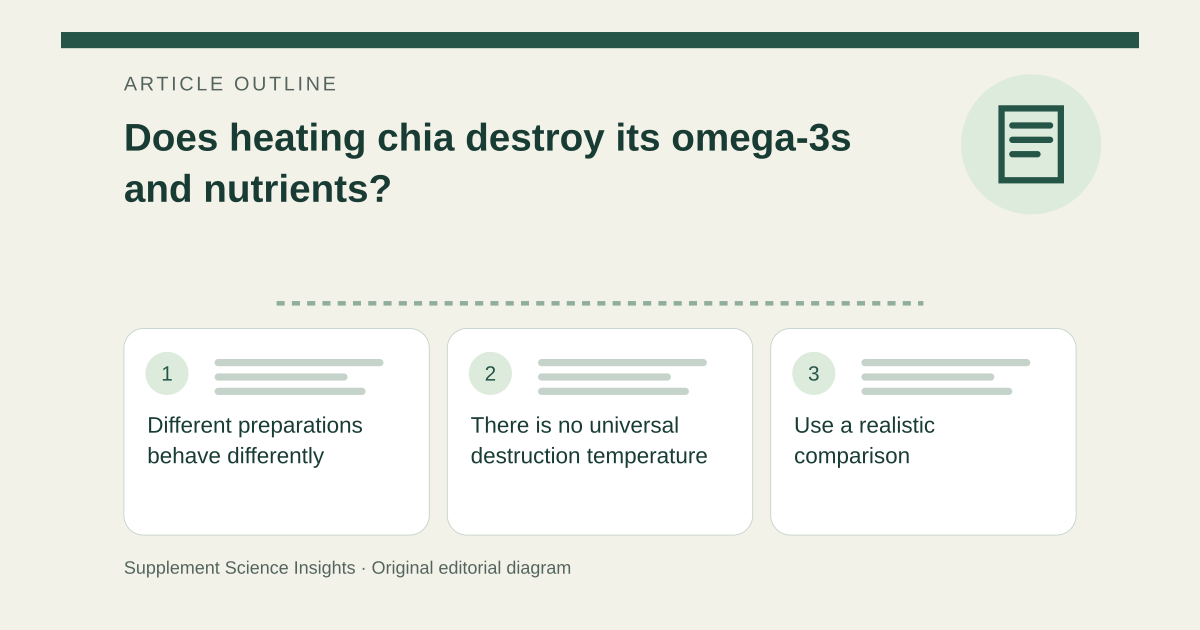
Different preparations behave differently
A processing review describes oxidation and composition changes during roasting and heating of chia oil, while also describing nutritious baked foods containing chia. Whole seeds, ground seeds and extracted oil are different materials. A change in one fatty acid’s percentage is not necessarily the same percentage loss from the original serving. [1]
There is no universal destruction temperature
The inspected evidence does not support one cutoff at which all nutrients disappear. Water, oxygen exposure and time also matter. For routine meals, avoid unnecessarily prolonged high heat or burnt food rather than assuming every cooked chia recipe is nutritionally empty. [1]
Use a realistic comparison
Imagine choosing between chia stirred into warm porridge and chia oil heated intensely for a long period. The review cannot assign the same retention rate to both. Follow the food or oil’s storage and preparation instructions, and do not use laboratory processing percentages as a precise home-cooking calculation. [1][2]
| Detail | Meaning |
|---|---|
| Whole seeds in a meal | Food matrix matters |
| Extracted oil under high heat | Different exposure |
| Exact retention | Requires relevant measurements |
Sources for this article
- A comprehensive review of conventional, green, and assisted techniques for chia oil extraction
Source consulted: 2026-09-21. This is a reference resource, not a claim that we conducted the studies or tested a product. - Dietary Supplements: What You Need to Know - Consumer
Source consulted: 2026-09-21. This is a reference resource, not a claim that we conducted the studies or tested a product.