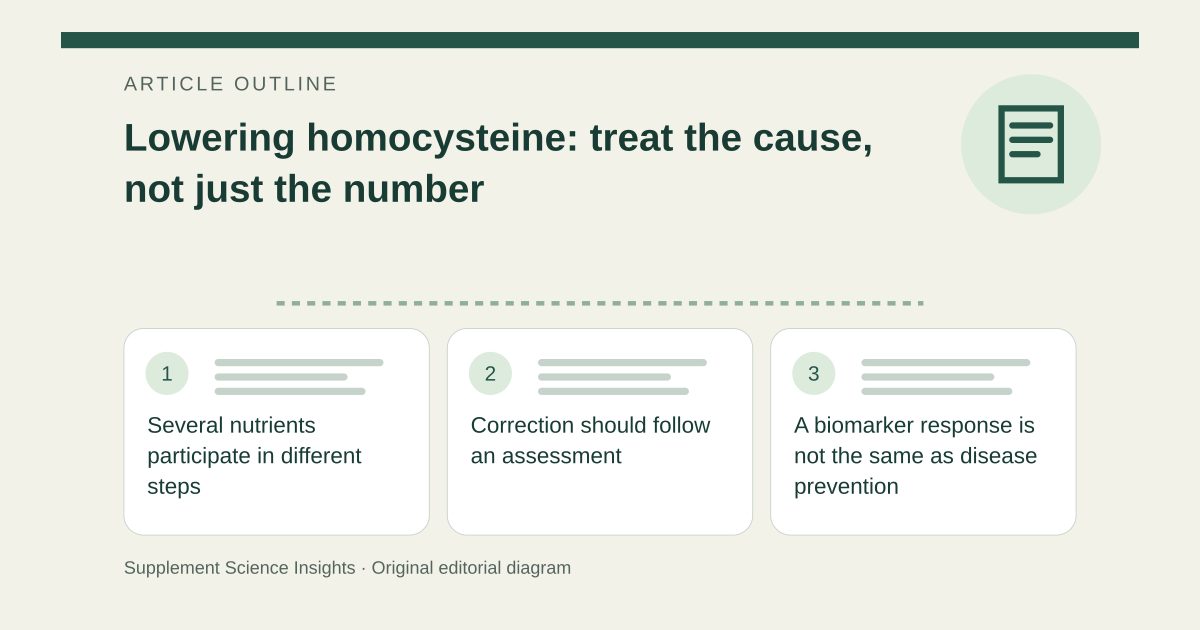
Several nutrients participate in different steps
Folate and vitamin B12 support a pathway that converts homocysteine back toward methionine. Vitamin B6 supports enzymes in the pathway that proceeds toward cysteine. These relationships explain why deficiencies can affect the blood result. [1][2]
They do not imply that every elevated result is caused by inadequate intake of all three vitamins. Kidney disease, thyroid disease and other factors can also matter, and a rare inherited disorder requires a different clinical framework. [1][2]
Correction should follow an assessment
When a relevant deficiency is present, correcting it addresses a nutritional problem as well as potentially changing homocysteine. The appropriate route and amount depend on the deficiency, absorption and the person’s circumstances. A food-only approach is not automatically sufficient for every diagnosed deficiency. [1][2]
If the elevation has another cause, adding a broad high-dose vitamin stack may fail to address it. The useful next step is to establish what the result means in context, rather than assuming more vitamins are always the answer. [1][2]
A biomarker response is not the same as disease prevention
MedlinePlus notes that lowering homocysteine usually does not reduce heart-attack or stroke risk. This distinction explains why routine population screening is not generally recommended simply to find a number to lower. [1][2]
A study showing a lower laboratory value answers a different question from one showing fewer clinical events. Existing cardiovascular care should not be replaced by supplements based on that marker alone. [1][2]
Record the clinical benefit separately
Imagine an intervention lowers a laboratory result but the study does not measure heart attacks or strokes. The result supports a biomarker claim within the study conditions. It cannot establish a reduction in those unmeasured outcomes.
| Observation | What it means |
|---|---|
| Vitamin deficiency | A potentially treatable cause |
| Lower homocysteine | A laboratory response |
| Fewer cardiovascular events | A separate clinical endpoint |
Sources for this article
- MedlinePlus: Homocysteine test
Source consulted: 2026-09-17. This is a reference resource, not a claim that we conducted the studies or tested a product. - Lu: Glutathione synthesis — foundational mechanistic review
Source consulted: 2026-09-17. This is a reference resource, not a claim that we conducted the studies or tested a product.