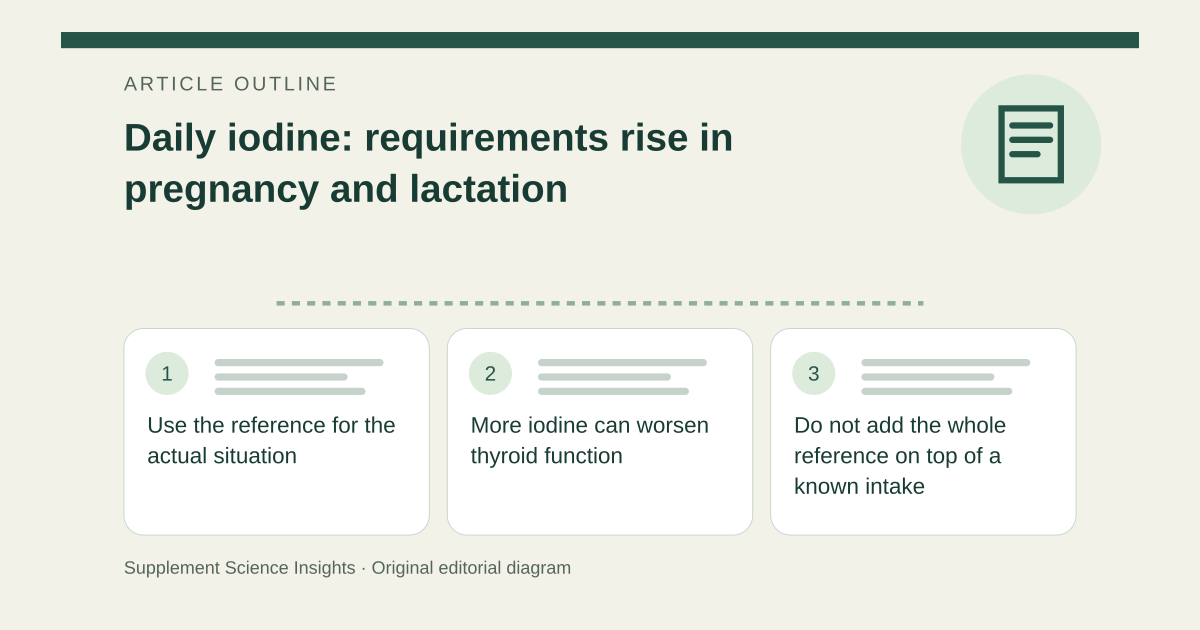
Use the reference for the actual situation
ODS lists 150 micrograms daily for adults, 220 micrograms during pregnancy and 290 micrograms during lactation. Children have different references. The values concern total nutritional intake rather than a standalone supplement quantity. [1]
The source also notes that international guidance can use different pregnancy values. A clinician should apply the relevant guidance to the person’s food pattern and prenatal product rather than combine several recommendations into a larger dose. [1]
More iodine can worsen thyroid function
Both inadequate and excessive iodine can disrupt thyroid function. People with certain thyroid disorders may react adversely at exposures tolerated by others, so a general upper limit does not guarantee individual suitability. [1]
The adult upper limit is 1,100 micrograms daily from food and supplements. It is a ceiling, not a target. Kelp weight does not disclose iodine content reliably; check the actual nutrient amount and existing multivitamin or prenatal contributions. [1]
Do not add the whole reference on top of a known intake
Imagine a hypothetical dietary record already supplies an estimated 150 micrograms iodine daily. A second product adding another 150 micrograms brings the recorded total to 300, not 150. The calculation does not establish whether that total is appropriate for the person or life stage.
| Entry | Meaning |
|---|---|
| Food estimate: 150 mcg | Existing contribution |
| Supplement: 150 mcg | Additional contribution |
| Total: 300 mcg | Requires separate suitability assessment |
Sources for this article
- NIH ODS: Iodine
Source consulted: 2026-09-17. This is a reference resource, not a claim that we conducted the studies or tested a product.