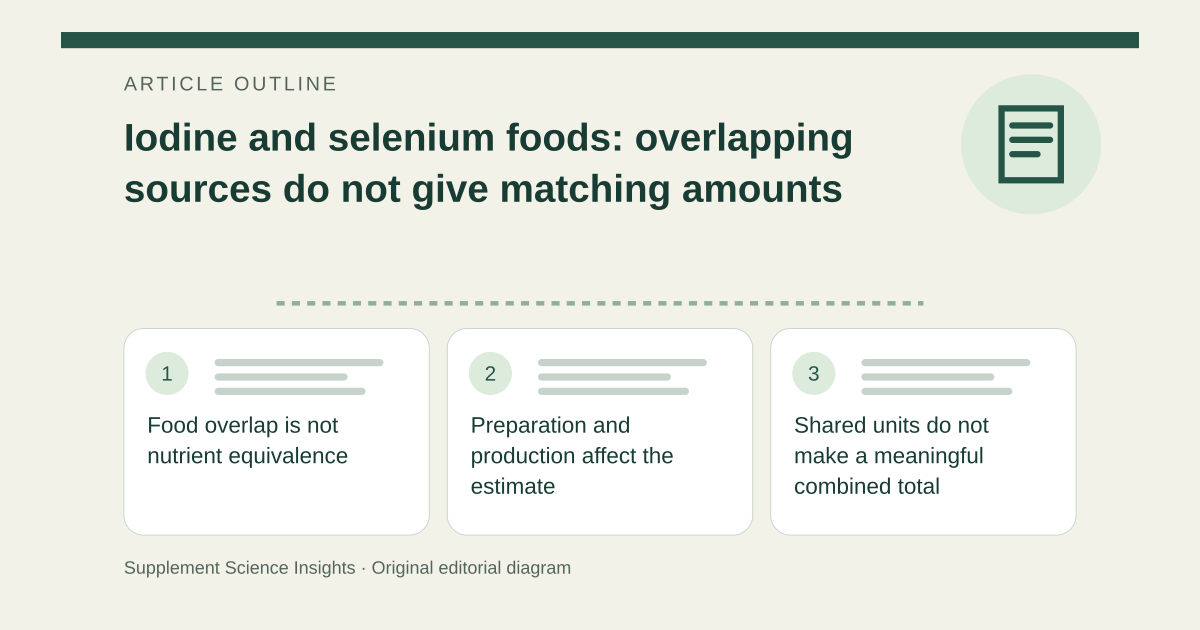
Food overlap is not nutrient equivalence
The ODS summaries identify seafood and eggs as sources of iodine and selenium. Their tables list about 31 micrograms iodine and 15 micrograms selenium in a large hard-boiled egg. Each value belongs to its own nutrient record. [1][2]
Other foods illustrate the difference: seaweed iodine varies greatly by species, while Brazil nuts can contain unusually high selenium. Neither category should be treated as a reliably balanced two-mineral supplement. [1][2]
Preparation and production affect the estimate
ODS reports substantial variation in milk iodine depending partly on feed and dairy-processing practices. Seaweed iodine concentrations also span a wide range, making a generic seaweed weight an unreliable personal dose. [1][2]
Selenium in plant foods varies with soil and other growing conditions. A food-table value can guide an estimate, but the same visible food portion need not deliver the same mineral content everywhere. The uncertainty should not be hidden by adding the two microgram numbers together. [1][2]
Shared units do not make a meaningful combined total
Imagine an egg estimate lists 31 micrograms iodine and 15 micrograms selenium. Adding them produces 46 micrograms of two different substances, which is not a useful adequacy score for either. Compare each amount with its own nutrient reference instead.
| Entry | Meaning |
|---|---|
| Iodine estimate | Compare with iodine needs |
| Selenium estimate | Compare with selenium needs |
| Sum of the two | Not a thyroid-support potency score |
Sources for this article
- NIH ODS: Iodine
Source consulted: 2026-09-17. This is a reference resource, not a claim that we conducted the studies or tested a product. - NIH ODS: Selenium
Source consulted: 2026-09-17. This is a reference resource, not a claim that we conducted the studies or tested a product.