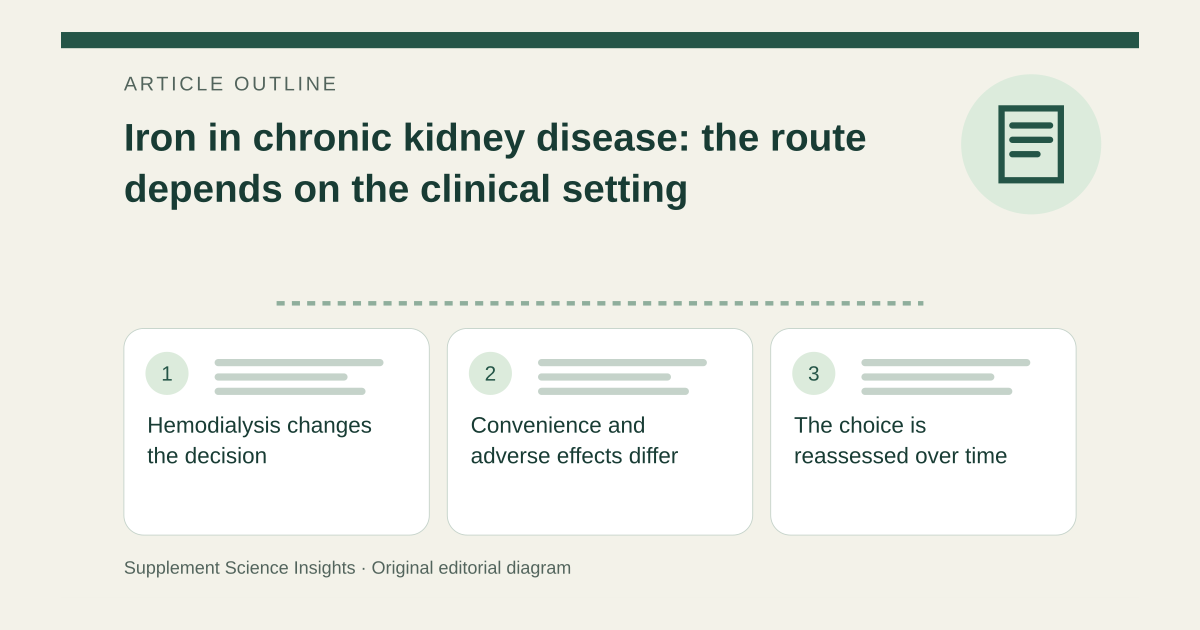
Hemodialysis changes the decision
For people with anemia receiving hemodialysis who are starting iron therapy, KDIGO suggests intravenous rather than oral iron. For anemia in CKD without hemodialysis, either route may be considered according to clinical circumstances and preferences. These are different populations, not a universal rule that everyone with kidney disease needs an infusion. [1]
Convenience and adverse effects differ
Oral iron avoids intravenous access and can be less costly, but gastrointestinal intolerance can limit use. Intravenous treatment requires an appropriate clinical setting and carries infusion-reaction risks. The guideline considers efficacy, availability, cost and preference alongside tolerability. [1]
The choice is reassessed over time
Hemoglobin and iron measures guide follow-up. An inadequate response or poor tolerance can lead the treating team to reconsider the route. The guideline notes limited comparative evidence for choosing a single formulation as universally best. [1]
A retail ranking cannot replace a kidney-care plan. Bring the exact product, current test results and dialysis status to the discussion. Do not add over-the-counter iron without accounting for iron already delivered during treatment. [1]
A shared diagnosis does not imply a shared route
Imagine one person receives iron during scheduled hemodialysis while another manages earlier-stage CKD with an oral regimen. Their different routes do not, by themselves, show that one is receiving inferior care. The indication, response and constraints differ.
| Detail | Interpretation |
|---|---|
| Hemodialysis with anemia | A distinct guideline setting |
| Other CKD settings | Individualized route selection |
| Existing treatment | Must be included before adding iron |
Sources for this article
- KDIGO 2026 Anemia in CKD Guideline: Executive Summary
Source consulted: 2026-09-17. This is a reference resource, not a claim that we conducted the studies or tested a product.