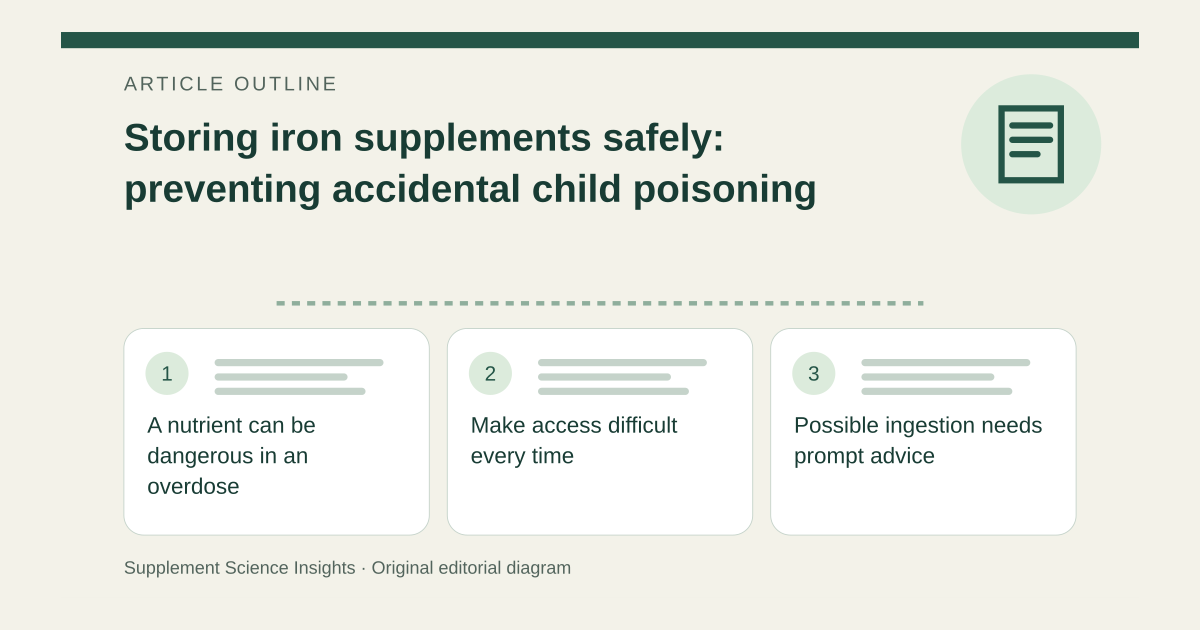
A nutrient can be dangerous in an overdose
Iron is essential, but concentrated supplements can cause severe poisoning. NIH ODS and the NHS warn that accidental overdose in young children can be fatal. A vitamin or mineral label should not make a product seem harmless to leave within reach. [1][2]
The concern applies to iron-containing combinations as well as standalone iron. A prenatal or multivitamin can be overlooked because the package is not labeled simply “iron.” Include those products in the household storage review. [1][2]
Make access difficult every time
MedlinePlus advises keeping iron out of children’s reach and storing tablets in a cool place; a warm, humid bathroom cabinet can be unsuitable. Retain the original container and label so the product and strength are identifiable. [3]
A practical storage routine should account for bags, bedside tables, visitors’ medicines and doses set out temporarily. A secure storage location is only useful if the product returns there after each use. This is a prevention step, not a guarantee that packaging can never be opened. [3]
Possible ingestion needs prompt advice
If a child swallows an iron tablet or may have taken an excessive amount, contact poison control or emergency medical services promptly. Do not wait to see whether the child becomes ill. MedlinePlus specifically directs caregivers to contact poison control right away after a child swallows an iron pill. [3][1]
Keep the container available and report the possible time and amount without guessing beyond what is known. Do not use an online toxicity threshold to decide that an uncertain ingestion is safe. [3][1]
Uncertainty is information to report
Imagine an open bottle is found near a child and the number of missing tablets is unknown. The accurate report is that the amount is uncertain, together with the product label and likely time window. Inventing a reassuring tablet count can mislead the assessment.
| Record | Why it matters |
|---|---|
| Original container | Identifies ingredient and strength |
| Possible time of ingestion | Helps the clinical assessment |
| Unknown number of tablets | State uncertainty; do not invent a count |
Daily intake guidance is not an overdose assessment
An RDA describes nutritional intake, and an upper limit describes a usual-intake safety framework. Neither replaces urgent evaluation of a possible accidental ingestion. A child’s risk cannot be judged by comparing an unknown acute amount with an adult daily reference. [1]
This page does not provide home-treatment instructions. Its purpose is to prevent access and support prompt professional assessment if prevention fails. [1]
Sources for this article
- NIH ODS — Iron: Health Professional Fact Sheet
Source consulted: 2026-09-17. This is a reference resource, not a claim that we conducted the studies or tested a product. - NHS — Iron deficiency anaemia
Source consulted: 2026-09-17. This is a reference resource, not a claim that we conducted the studies or tested a product. - MedlinePlus — Taking iron supplements
Source consulted: 2026-09-17. This is a reference resource, not a claim that we conducted the studies or tested a product.