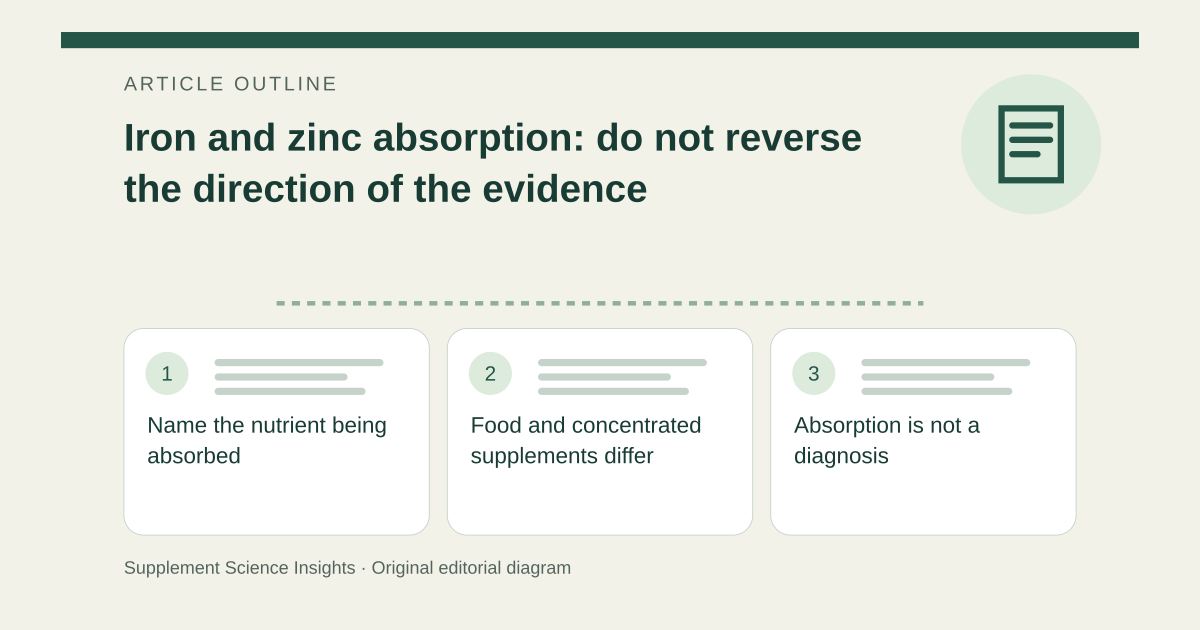
Name the nutrient being absorbed
The ODS zinc review reports that taking supplements containing at least 25 mg elemental iron at the same time as zinc supplements can reduce zinc absorption and plasma zinc concentrations. This is an iron-exposure effect on zinc handling in a specified context. [1][2]
Reversing the sentence into zinc causes low iron changes the claim. Mineral interactions can be complex, but this particular evidence should not be used as proof of the reversed statement or of anemia in an individual. [1][2]
Food and concentrated supplements differ
ODS distinguishes the supplement interaction from iron added to enriched or fortified foods, which does not show the same significant interference with zinc absorption. A warning about simultaneous concentrated supplements therefore should not become an instruction to avoid every meal containing both nutrients. [1][2]
The actual amounts, forms and reason for each supplement matter. Ask a pharmacist or clinician to review a required combination rather than inventing a universal spacing interval from an absorption observation. [1][2]
Absorption is not a diagnosis
A finding about reduced absorption does not establish that a person has deficient stores or anemia. Iron status is assessed with blood measurements and clinical context; symptoms and an ingredient list do not identify the cause. [1][2]
If iron results are low during zinc use, record the zinc exposure but also assess the usual clinical possibilities. Do not assume one supplement explains the entire result. [1][2]
Keep the arrow pointing the right way
Imagine a study tests how supplement A changes absorption of nutrient B. It cannot automatically establish the effect of B on A. The exposure and measured outcome need to stay in their original roles.
| Detail | Interpretation |
|---|---|
| Iron supplement exposure | The studied input |
| Zinc absorption | The affected measure |
| Personal iron deficiency | A separate assessment |
Sources for this article
- NIH ODS: Zinc — Health Professional Fact Sheet
Source consulted: 2026-09-17. This is a reference resource, not a claim that we conducted the studies or tested a product. - NIH ODS: Iron — Health Professional Fact Sheet
Source consulted: 2026-09-17. This is a reference resource, not a claim that we conducted the studies or tested a product.