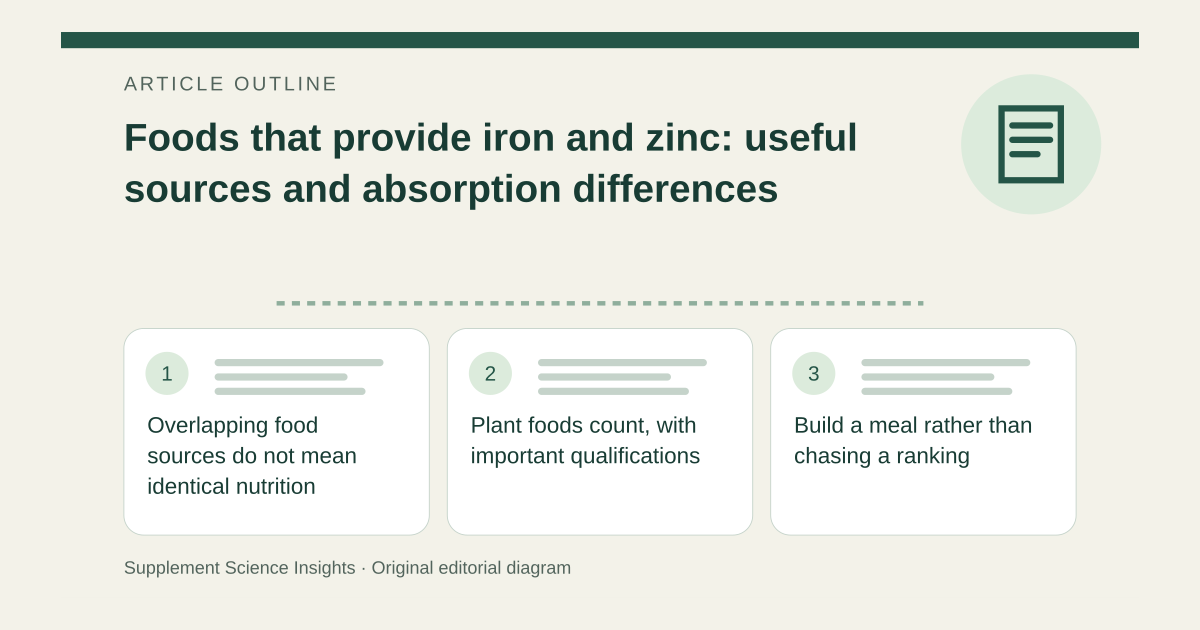
Overlapping food sources do not mean identical nutrition
Meat and seafood can provide both iron and zinc. Beans, nuts and whole grains can also contribute, and some breakfast cereals are fortified. The amount of one mineral in a food should not be used to guess the amount of the other. [1][2]
ODS identifies oysters as particularly rich in zinc, but that does not make them a necessary food or a complete answer to iron needs. Dietary preferences, portion size and the rest of the menu determine which sources are practical. [1][2]
Plant foods count, with important qualifications
Iron occurs as heme and nonheme iron. Plant foods and fortified foods provide nonheme iron, whose absorption is influenced by the meal. Vitamin C can enhance nonheme iron absorption; phytates and some other food components can inhibit it. [1][2]
Plant foods also contain zinc, but phytates can reduce its absorption. That is a reason to plan a varied plant-based diet, not a reason to describe legumes and whole grains as nutritionally worthless. ODS discusses lower bioavailability separately from the measured mineral content. [1][2]
Build a meal rather than chasing a ranking
Imagine a plant-based lunch built around beans and whole grains, with a vitamin-C-containing vegetable or fruit. It supplies several foods relevant to mineral intake while considering the meal’s effect on nonheme iron absorption.
This example does not calculate absorbed milligrams or guarantee that the day meets either requirement. Those claims would need portions, preparation details, other meals and the person’s age and circumstances.
| Observation | Interpretation |
|---|---|
| Food and portion | Use comparable serving sizes |
| Iron content | Record separately from zinc |
| Meal context | Consider nonheme absorption without inventing a percentage |
Food planning and deficiency treatment are different tasks
A food list cannot diagnose low iron or zinc status. Requirements vary, and an established deficiency or absorption disorder can require assessment beyond a menu change. Iron status in particular involves more than whether a person eats meat. [1][2]
Use food labels and reliable composition data when comparing equivalent serving sizes. Keep the two minerals in separate columns rather than treating “high in minerals” as a quantified claim about both. [1][2]
Sources for this article
- NIH ODS — Iron: Health Professional Fact Sheet
Source consulted: 2026-09-17. This is a reference resource, not a claim that we conducted the studies or tested a product. - NIH ODS — Zinc: Health Professional Fact Sheet
Source consulted: 2026-09-17. This is a reference resource, not a claim that we conducted the studies or tested a product.