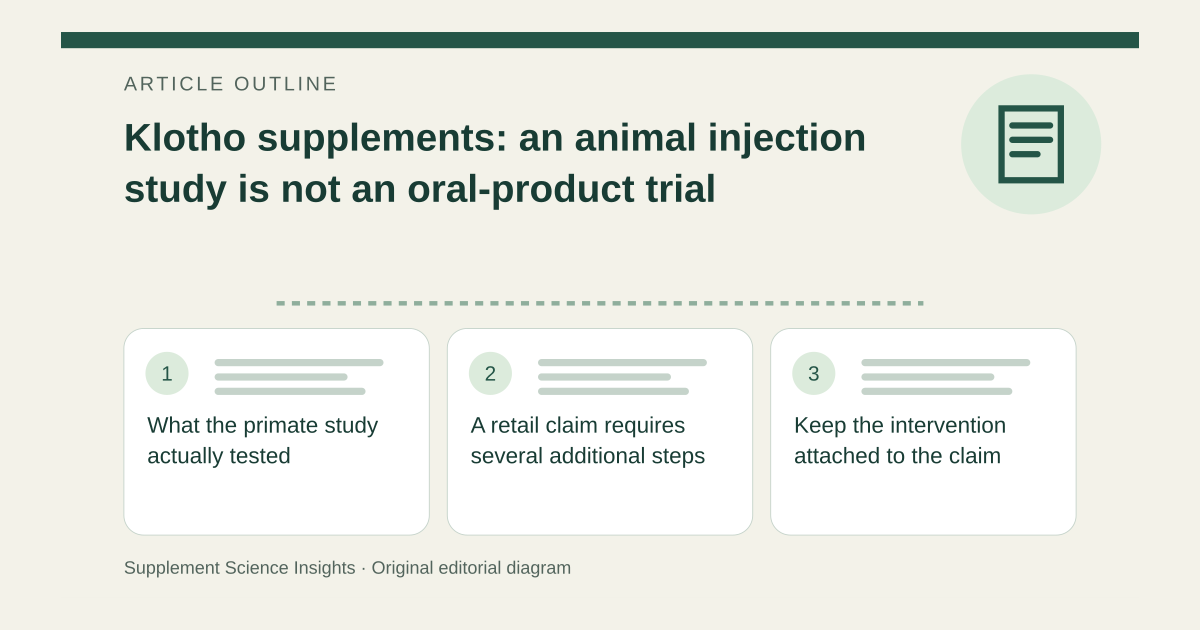
What the primate study actually tested
Researchers administered klotho protein to aged rhesus macaques and measured performance on memory tasks. The overall study involved 18 monkeys, with smaller groups contributing to particular treatment comparisons. [1]
A lower dose improved some memory outcomes, while higher doses did not show the same benefit. The result does not support a simple more-is-better assumption. [1]
A retail claim requires several additional steps
An oral product would need evidence that its actual ingredients and route produce a relevant exposure and meaningful human outcome. A capsule marketed to support klotho is not necessarily the injected protein used in this study. [1]
The paper discloses patents and biotechnology-company relationships involving investigators. Those interests do not invalidate the findings, but strengthen the need for independent replication and careful interpretation. [1]
Keep the intervention attached to the claim
Imagine a capsule advertisement cites a monkey injection experiment. That citation does not establish absorption, improved human memory or longer life from taking the capsule.
| Detail | Interpretation |
|---|---|
| Study subjects | Aged rhesus macaques |
| Intervention | Administered klotho protein |
| Retail oral benefit | Not established by that experiment |
Sources for this article
- Longevity factor klotho enhances cognition in aged nonhuman primates - PMC
Source consulted: 2026-09-18. This is a reference resource, not a claim that we conducted the studies or tested a product.