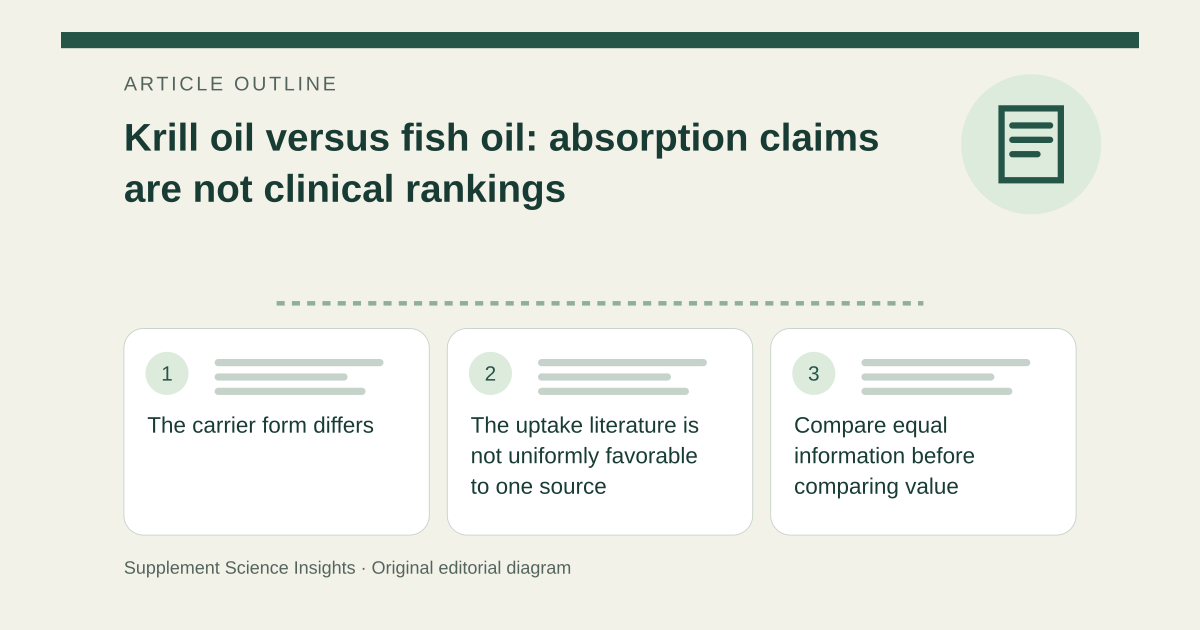
The carrier form differs
ODS describes krill oil as containing omega-3s primarily in phospholipids. Fish-oil supplements can contain triglycerides or other forms, depending on processing. [1]
These differences can affect how a formulation is studied. They do not eliminate the need to compare the actual EPA and DHA supplied, rather than just the amount of total oil or number of capsules. [1]
The uptake literature is not uniformly favorable to one source
The ODS summary reports that some studies suggest higher bioavailability for krill-oil phospholipids, while others do not. It does not present every krill formulation as a proven clinical improvement over every fish-oil formulation. [1]
A blood fatty-acid increase is also not the same endpoint as fewer cardiovascular events. Even a valid absorption advantage in one comparison cannot automatically answer that different question. [1]
Compare equal information before comparing value
Imagine two labels advertise 1,000 milligrams of oil, but declare different EPA and DHA amounts. Equal oil weights do not make their active fatty-acid exposures equal.
If one label leaves EPA or DHA unclear, a source name such as krill does not fill the gap. Record the uncertainty rather than inventing an equivalence ratio.
| Detail | Interpretation |
|---|---|
| Oil source and form | Composition |
| Blood fatty-acid change | An uptake-related endpoint |
| Clinical benefit | Requires relevant outcome evidence |
Keep the conclusion narrower than the marketing claim
A defensible comparison identifies the formulation, EPA/DHA amount, study conditions and outcome. Price or a phospholipid claim alone does not establish better health effects. [1]
No retail product, purity certificate or personal regimen is verified here. The article uses the ODS synthesis and does not independently reappraise every head-to-head trial. [1]
Sources for this article
- NIH ODS: Omega-3 Fatty Acids
Source consulted: 2026-09-17. This is a reference resource, not a claim that we conducted the studies or tested a product.