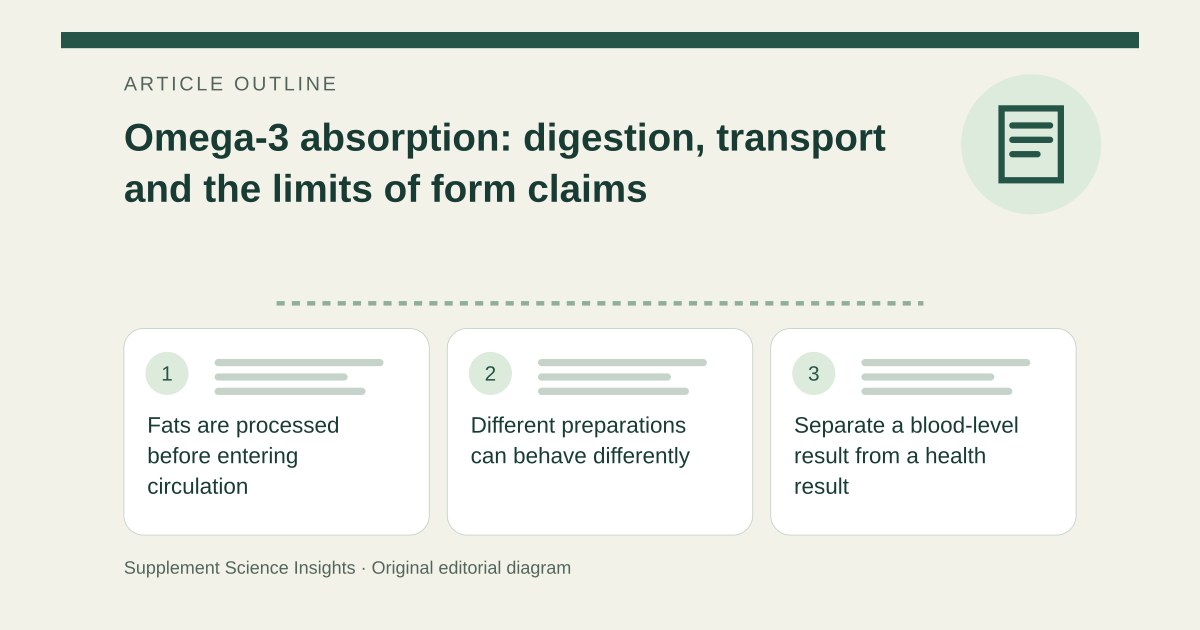
Fats are processed before entering circulation
Dietary fats are broken down in the intestine into products including free fatty acids and monoglycerides. These enter bile-containing micelles, which help deliver them to intestinal cells for absorption. [1]
Inside those cells, fats are repackaged into transport particles such as chylomicrons. They reach the circulation through the lymphatic system and are delivered to tissues for use, storage or further metabolism. [1]
Different preparations can behave differently
ODS discusses triglycerides, free fatty acids, ethyl esters and phospholipids among omega-3 supplement forms. Some forms have somewhat higher bioavailability than ethyl esters in the cited comparisons, while all of the discussed forms can raise plasma EPA and DHA. [1]
The meaningful comparison requires the amount of EPA and DHA, the formulation and the measured endpoint. A capsule’s total oil mass is not automatically the same as its EPA-plus-DHA amount. [1]
Separate a blood-level result from a health result
Imagine one preparation raises a blood fatty-acid measure more than another under study conditions. That finding addresses uptake or status in that comparison.
It does not by itself show fewer heart attacks, better cognition or superior results for every user. Those outcomes would need to be measured in appropriate studies.
| Detail | Interpretation |
|---|---|
| More EPA/DHA in blood | A status or uptake endpoint |
| Fewer heart attacks | A separate clinical endpoint |
| Total oil on a bottle | Not automatically the active fatty-acid amount |
A general pathway is not a personal absorption test
The ODS description of efficient fat absorption does not measure an individual with a digestive disorder. Nor does it certify the amount, freshness or purity in a specific retail product. [1]
This explanation supports interpreting a formulation claim, not choosing a high-dose regimen or substituting one product for a prescribed preparation. [1]
Sources for this article
- NIH ODS: Omega-3 Fatty Acids
Source consulted: 2026-09-17. This is a reference resource, not a claim that we conducted the studies or tested a product.