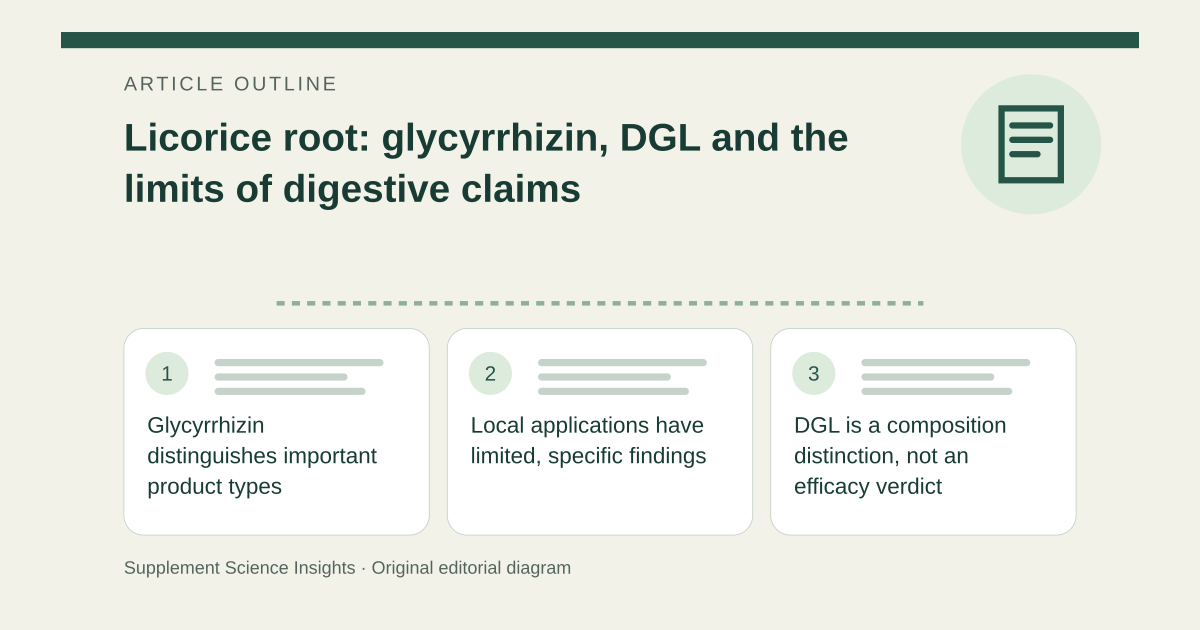
Glycyrrhizin distinguishes important product types
Licorice root contains glycyrrhizin, also called glycyrrhizic acid. Deglycyrrhizinated licorice, usually abbreviated DGL, is processed to remove that constituent. These preparations should not be treated as interchangeable in a research or safety comparison. [1]
A package should clearly identify the material rather than relying on the word licorice. Flavoring in food, concentrated oral products, gargles and topical gels represent different exposures and need route-specific interpretation. [1]
Local applications have limited, specific findings
NCCIH describes preliminary or limited findings for mouth rinses, gargles and topical products in settings such as canker sores or post-intubation throat discomfort. Some studies involved licorice alongside another treatment, so the background treatment remains part of the result. [1]
Evidence for digestive symptoms from licorice alone is unclear. A favorable study of a multi-herb formula cannot establish licorice's independent contribution. Nor does a local mouth-rinse finding demonstrate that swallowing an extract treats a gastrointestinal condition. [1]
DGL is a composition distinction, not an efficacy verdict
Removing glycyrrhizin addresses a particular exposure question. It does not prove that the resulting product works for reflux, ulcers or an unspecified digestive complaint. Those claims still require research on the actual formulation and outcome.
For a comparison, record whether the product declares DGL, the amount of the preparation and any specification about remaining constituents. Do not invent a residual amount or a conversion between DGL and ordinary root. A manufacturing term cannot supply an absent clinical endpoint. A combination chewable should also disclose its other active ingredients, because a result for that mixture would not isolate the effect of licorice.
Glycyrrhizin can cause serious harm
Glycyrrhizin-containing products can cause serious adverse effects, including abnormal heart rhythm and cardiac arrest, especially with larger or prolonged exposure. Severe effects have also been reported with smaller amounts in susceptible people, including those with hypertension or heart or kidney conditions. [1]
Interactions with corticosteroids have been reported. High oral exposure during pregnancy is unsafe, and breastfeeding information is limited. DGL has a different short-term safety record, but that does not establish indefinite safety for every product or person. [1]
Keep a route mismatch visible
Imagine a fictional study tests a licorice gargle for throat discomfort following intubation. A capsule marketed for indigestion cannot use that result as direct evidence: route, clinical setting and outcome all differ.
If the capsule also says DGL while the study preparation is unspecified, another composition question remains. The example identifies missing information rather than supplying a therapeutic conversion.
| Fictional comparison | Mismatch |
|---|---|
| Gargle versus capsule | Route |
| Post-intubation throat pain versus indigestion | Outcome |
| DGL versus unspecified preparation | Composition unresolved |
Read the constituent and the clinical question together
A useful licorice assessment begins with glycyrrhizin status and the exact proposed use. This reference does not recommend a digestive remedy or a preoperative regimen. The serious safety concerns associated with ordinary licorice deserve prominent consideration.
Sources for this article
- NCCIH — Licorice root: Usefulness and Safety
Source consulted: 2026-09-17. This is a reference resource, not a claim that we conducted the studies or tested a product.