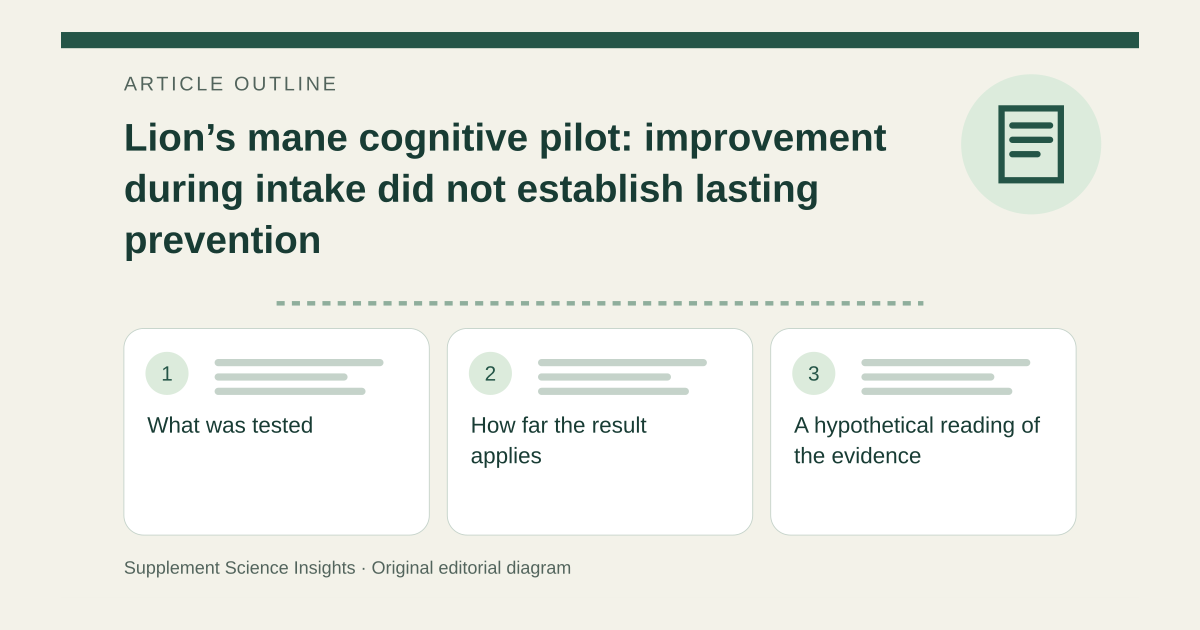
What was tested
Thirty Japanese adults aged 50–80 with mild cognitive impairment were randomized to lion’s-mane dry-powder tablets or placebo for 16 weeks. Researchers then observed them for four further weeks. [1]
The active group scored better than placebo at weeks 8, 12 and 16. Scores declined after supplementation ended. The outcome was a rating scale based on the revised Hasegawa dementia scale. [1]
How far the result applies
These results do not establish dementia prevention, nerve repair or a lasting benefit after stopping. The small sample and selected population also limit transfer to healthy young adults or unrelated extracts. Funding and conflicts were not established from the retrieved abstract. [1]
A hypothetical reading of the evidence
Imagine a score improves during an intervention but later falls. Reporting only the best time point hides information about persistence.
| Detail | Interpretation |
|---|---|
| Study result | Limited to its measured outcomes |
| Other preparation | Equivalence not established |
| Broader claim | Needs separate evidence |
Sources for this article
- Improving effects of the mushroom Yamabushitake (Hericium erinaceus) on mild cognitive impairment: a double-blind placebo-controlled clinical trial - PubMed
Source consulted: 2026-09-19. This is a reference resource, not a claim that we conducted the studies or tested a product.