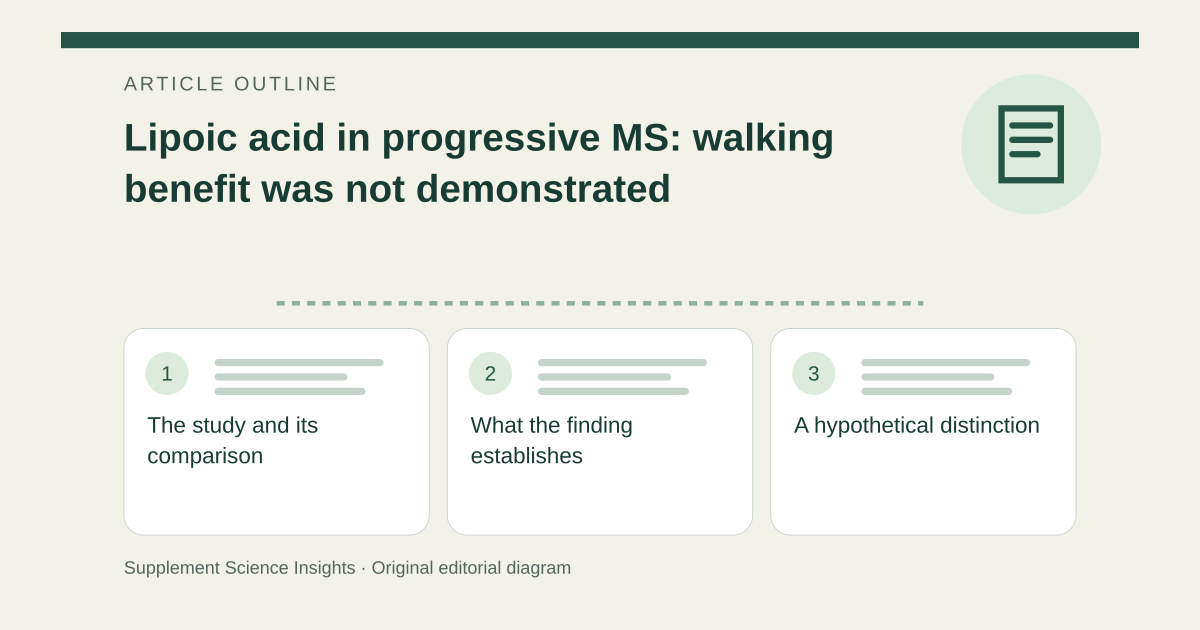
The study and its comparison
A two-year blinded trial compared oral lipoic acid with placebo in progressive multiple sclerosis. Reported groups included 54 and 61 participants; the primary outcome was timed walking speed. [1]
Lipoic acid did not slow worsening of walking speed or improve other clinical or patient-reported outcomes relative to placebo. Some brain-volume findings differed, but the active group had more proteinuria and more discontinuation. [1]
What the finding establishes
An imaging signal cannot override a negative functional endpoint. Unequal attrition also complicates interpretation. The study tested lipoic acid alone, not its combination with CoQ10. Funding and complete conflicts were not established from the abstract. These results do not support substituting a supplement for MS care or assuming that a familiar antioxidant has no relevant adverse effects. [1]
A hypothetical distinction
Imagine an MRI measure looks favorable while walking does not improve. Those outcomes support different conclusions.
| Detail | Interpretation |
|---|---|
| Measured outcome | Keep the endpoint specific |
| Study preparation | Not every retail product |
| Remaining uncertainty | Not resolved by a mechanism |
Sources for this article
- Lipoic Acid for Treatment of Progressive Multiple Sclerosis: A Phase 2 Randomized Clinical Trial.
Source consulted: 2026-09-19. This is a reference resource, not a claim that we conducted the studies or tested a product.