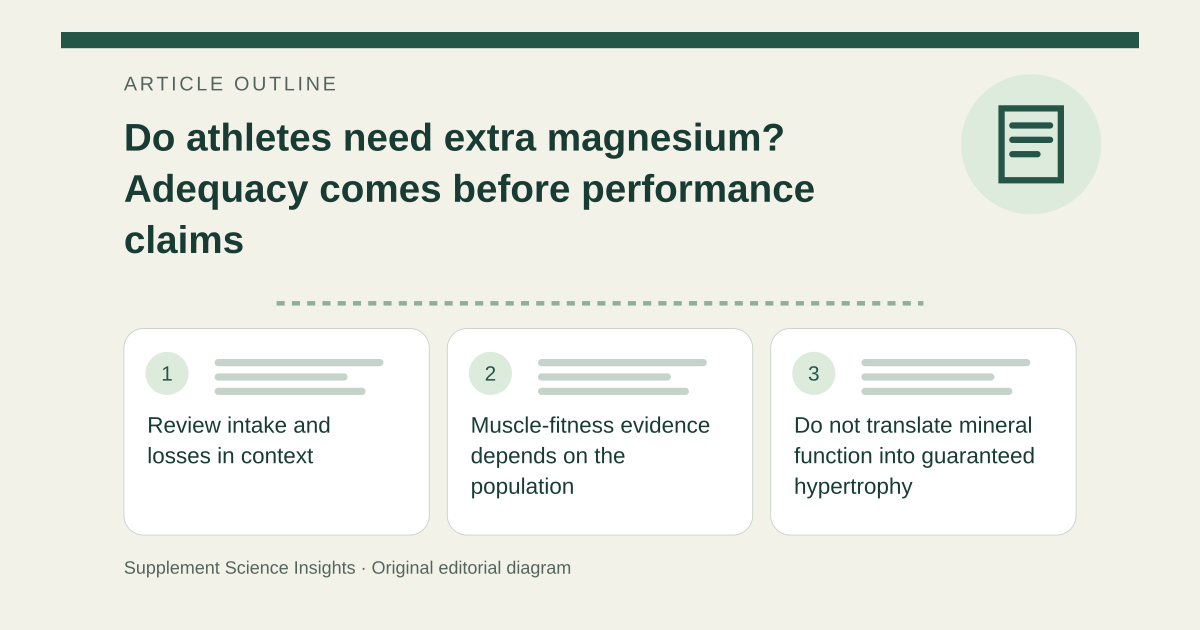
Review intake and losses in context
Magnesium supports nerve and muscle function. Dietary intake, gastrointestinal losses, health conditions and medicines can affect status. A demanding training period warrants attention to nutrition, but a cramp or poor session is not a reliable diagnosis of magnesium depletion. [1]
Muscle-fitness evidence depends on the population
A systematic review identified 14 randomized trials across physically active, untrained and older or alcohol-dependent populations. Its abstract did not find a clear muscle-fitness benefit in most athletes and active people with relatively high magnesium status; findings were more favorable in groups at greater deficiency risk. This older synthesis is not an exhaustive current review, and its funding was not established from the abstract. [2]
Do not translate mineral function into guaranteed hypertrophy
A requirement for muscle contraction or protein-related metabolism does not establish that extra magnesium adds muscle mass or strength in an adequately supplied athlete. Training, overall nutrition and the specific outcome remain important. Correcting a nutritional problem and seeking an additional ergogenic effect are different aims. [1][2]
Use an individualized amount rather than an athlete multiplier
NIH’s adult requirements include food, while the 350 mg daily adult upper limit concerns supplements and medicines. A sports label does not remove that boundary or kidney/medicine concerns. Seek a sports dietitian or clinician’s assessment when inadequate intake or substantial losses are suspected. [1]
Start with the gap
Imagine an athlete’s food intake is already adequate but strength has stalled. The plateau alone does not establish a magnesium need. Another athlete with ongoing diarrhea and low intake has a different reason for assessment; the same training schedule does not make their supplement decisions identical. [1]
| Information | Why it matters |
|---|---|
| Diet and losses | Assess likely adequacy |
| Starting mineral status | May influence response |
| Strength versus soreness | Different outcomes need different evidence |
Sources for this article
- Magnesium - Health Professional Fact Sheet
Source consulted: 2026-09-21. This is a reference resource, not a claim that we conducted the studies or tested a product. - The effect of magnesium supplementation on muscle fitness: a meta-analysis and systematic review.
Source consulted: 2026-09-21. This is a reference resource, not a claim that we conducted the studies or tested a product.