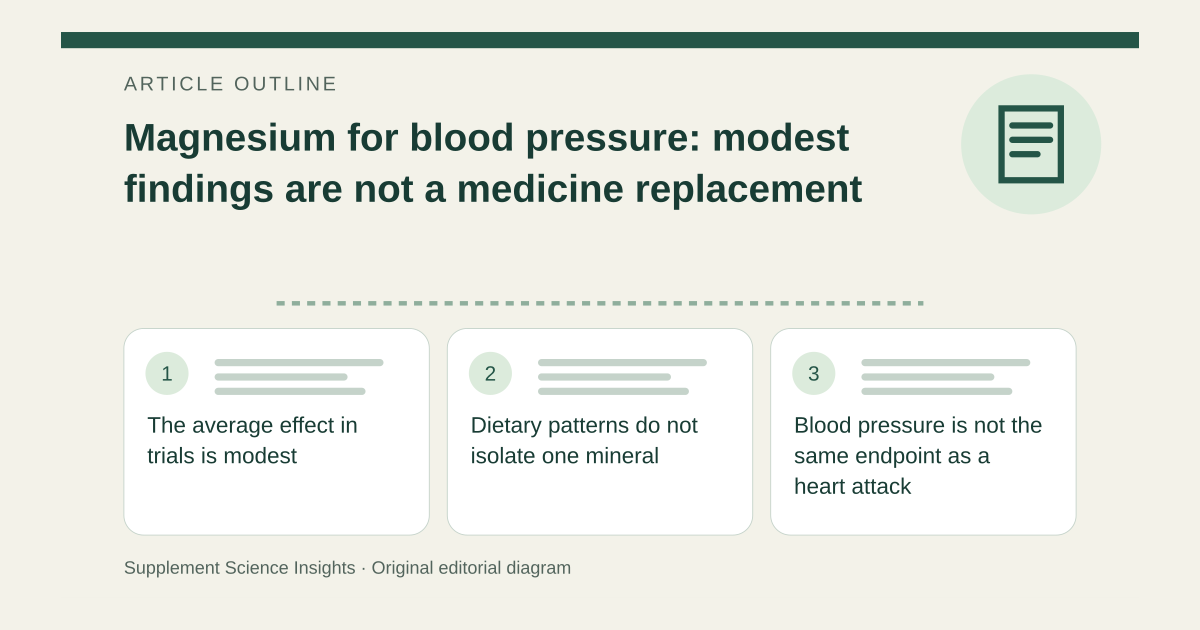
The average effect in trials is modest
NIH ODS describes magnesium supplementation as lowering blood pressure only marginally in clinical trials. A small average change can be worth studying, but it is not evidence that a supplement reliably controls hypertension for every person. [1]
The result also does not identify a universally best magnesium form. Trial participants, doses, duration and baseline blood pressure differ. A retail product’s form name cannot stand in for that clinical context. [1]
Dietary patterns do not isolate one mineral
Diets containing more vegetables, fruits and other nutrient-rich foods can supply more magnesium alongside potassium, calcium and many other dietary changes. ODS specifically notes that the blood-pressure benefit of the DASH dietary pattern cannot be attributed to magnesium alone. [1]
Observational associations between magnesium intake or blood levels and cardiovascular outcomes have similar attribution limits. People with different intakes may differ in many other ways. An association does not prove that adding a capsule recreates the observed risk difference. [1]
Blood pressure is not the same endpoint as a heart attack
A change in measured blood pressure and a reduction in heart attacks, strokes or deaths are separate outcomes. Evidence for the first should not be promoted as direct proof of all the others. ODS calls for better research to clarify magnesium’s contribution to cardiovascular prevention. [1]
Its discussion of the FDA qualified health claim also emphasizes inconsistent and inconclusive evidence. A permitted qualified claim is not equivalent to approval of a magnesium product as a hypertension medicine. [1]
A before-and-after reading has several possible explanations
Imagine someone starts a magnesium supplement while also improving sleep, changing diet and taking prescribed blood-pressure medicine more consistently. A lower reading afterward does not isolate the supplement’s effect. A comparison needs consistent measurement and attention to the other changes.
| Observation | Interpretation |
|---|---|
| Small average blood-pressure change | Does not predict every person’s response |
| A nutrient-rich dietary pattern | Does not isolate magnesium |
| Association with fewer events | Does not prove a capsule prevents those events |
Keep prescribed treatment and monitoring in place
Do not stop or reduce a blood-pressure medicine because magnesium has a physiological role or a modest trial effect. Review supplements with the treating clinician, especially when kidney function or diuretic use changes magnesium balance. [1]
Higher supplemental amounts can cause diarrhea and other harms. The page summarizes ODS rather than independently reappraising each trial, and it provides no blood-pressure treatment dose or product ranking. [1]
Sources for this article
- NIH ODS — Magnesium: Health Professional Fact Sheet
Source consulted: 2026-09-17. This is a reference resource, not a claim that we conducted the studies or tested a product.