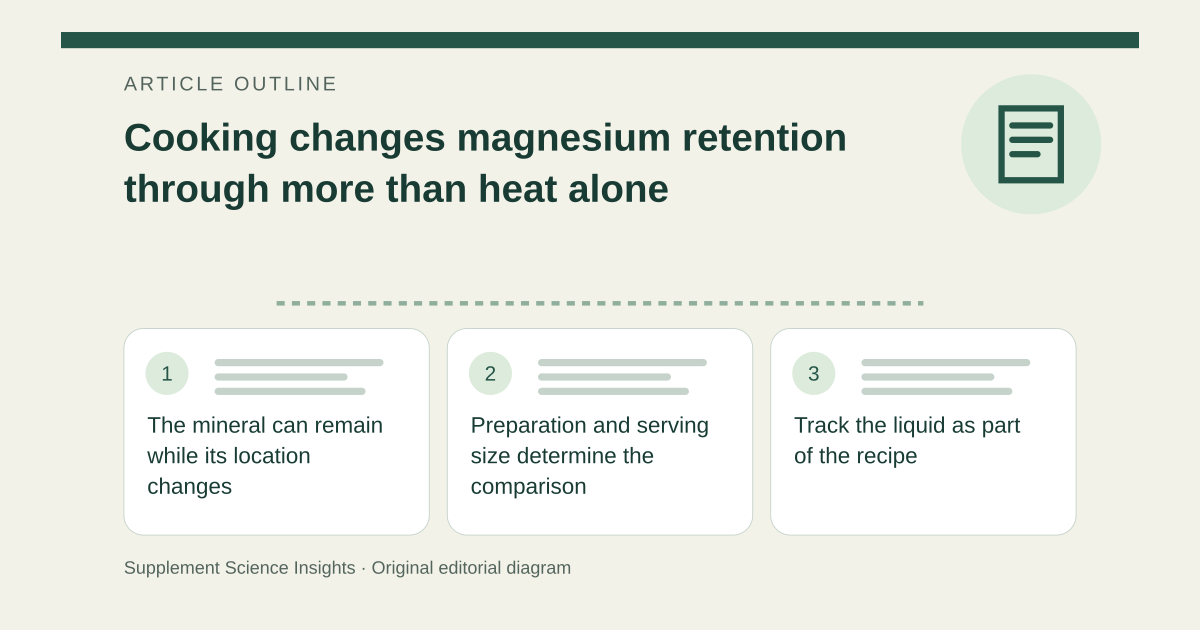
The mineral can remain while its location changes
Oklahoma State University distinguishes mineral elements from organic vitamins and notes that minerals remain in ash after burning. For normal food preparation, destroying a vitamin molecule and losing a mineral from the served portion are different processes. [1][2]
Iowa State University explains that cooking vegetables in water can move minerals into that water. If the liquid is discarded, the meal no longer includes all the mineral that was originally in the food. [1][2]
Preparation and serving size determine the comparison
Using the cooking liquid in a soup differs from draining and discarding it. Cutting, peeling and the amount of water used can also change what ends up on the plate; these sources do not supply a universal magnesium-loss percentage. [1][2]
Compare like portions when using food-composition data. A cooked serving and an equal weight of raw food can differ in water content, so different amounts per 100 grams do not by themselves prove that heat destroyed magnesium. [1][2]
Track the liquid as part of the recipe
Imagine vegetables release some minerals into their cooking water. Keeping that water in the final soup retains a contribution that would be excluded if the vegetables were drained.
| Detail | Interpretation |
|---|---|
| Heat exposure | Not elemental destruction |
| Discarded liquid | Can remove minerals |
| Per-100-gram values | Depend on water content |
Sources for this article
- Minerals and the Body | Oklahoma State University
Source consulted: 2026-09-19. This is a reference resource, not a claim that we conducted the studies or tested a product. - Steaming Vegetables • AnswerLine • Iowa State University Extension and Outreach
Source consulted: 2026-09-19. This is a reference resource, not a claim that we conducted the studies or tested a product.