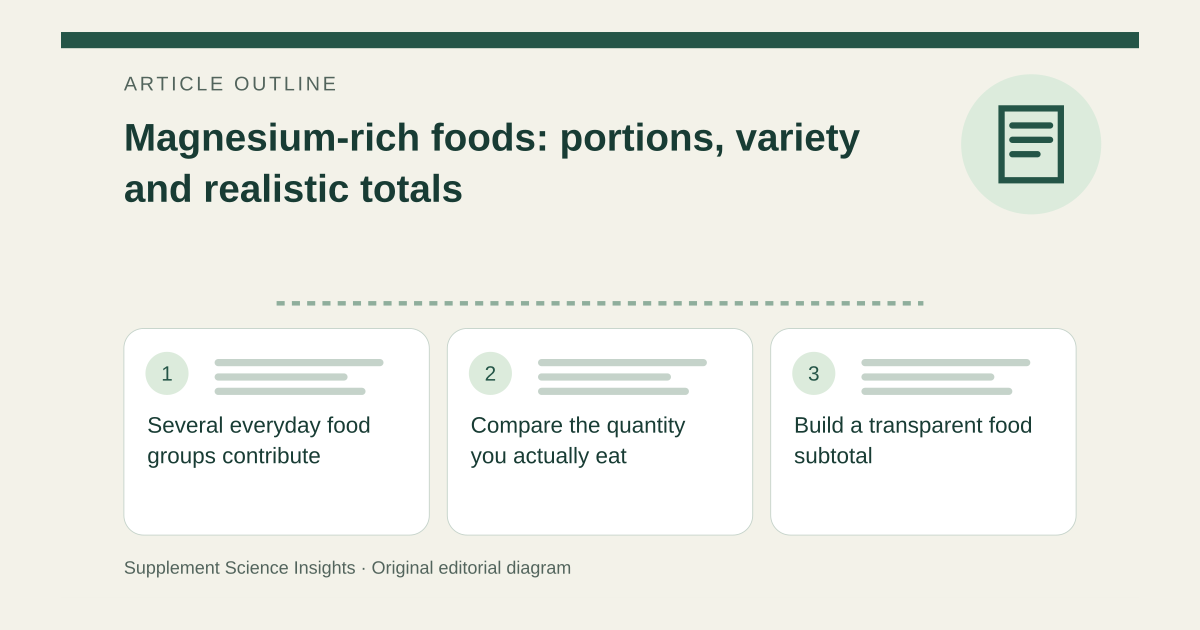
Several everyday food groups contribute
NIH ODS identifies green leafy vegetables, legumes, nuts, seeds and whole grains as good magnesium sources. A varied eating pattern can supply magnesium through several meals rather than relying on one special food. [1]
Refining grains can remove magnesium-rich components, while some cereals have magnesium added. Water can also contribute, but its magnesium content varies widely by source and brand. A mineral-water category name is not a measured amount. [1]
Compare the quantity you actually eat
The ODS table lists 80 mg in one ounce of dry-roasted almonds, 78 mg in half a cup of boiled spinach and 60 mg in half a cup of cooked black beans. These figures belong to those particular food entries and portions. [1]
A raw handful of spinach is not the same portion as half a cup after cooking, and an unspecified handful of nuts is not a verified ounce. Keep preparation and serving size attached to each number to avoid overstating intake. [1]
Build a transparent food subtotal
In a hypothetical meal record using those reference portions, almonds provide 80 mg and black beans 60 mg, for a subtotal of 140 mg. Adding the specified cooked-spinach portion would bring it to 218 mg. This is a calculation from reference entries, not laboratory testing of a meal.
The subtotal describes magnesium supplied. It does not mean that the entire amount is absorbed, that the rest of the diet is complete or that the meal corrects a diagnosed deficiency.
| Observation | Interpretation |
|---|---|
| Almonds, specified 1-ounce entry | 80 mg |
| Black beans, specified half-cup entry | 60 mg |
| Plus specified spinach portion | 218 mg combined |
Daily needs and supplement limits are different comparisons
U.S. adult RDAs range from 310 to 420 mg outside pregnancy, depending on age and sex. They refer to total intake. The separate 350 mg adult upper limit applies to supplements and medicines, not to magnesium naturally present in food. [1]
Do not use the supplemental limit to impose an unnecessary restriction on ordinary food sources in an otherwise healthy person. Kidney disease or a prescribed dietary plan requires individual advice rather than applying this general food guide. [1]
A food strategy has a defined purpose
Improving dietary variety supports intake but does not diagnose why someone has cramps or fatigue. Persistent symptoms or suspected losses need assessment. Food tables help describe a diet; they do not choose medical replacement treatment. [1]
No brand or isolated powder is necessary to answer this question. Use an appropriate label or food-composition entry when the food or portion differs from the examples. [1]
Sources for this article
- NIH ODS — Magnesium: Health Professional Fact Sheet
Source consulted: 2026-09-17. This is a reference resource, not a claim that we conducted the studies or tested a product.