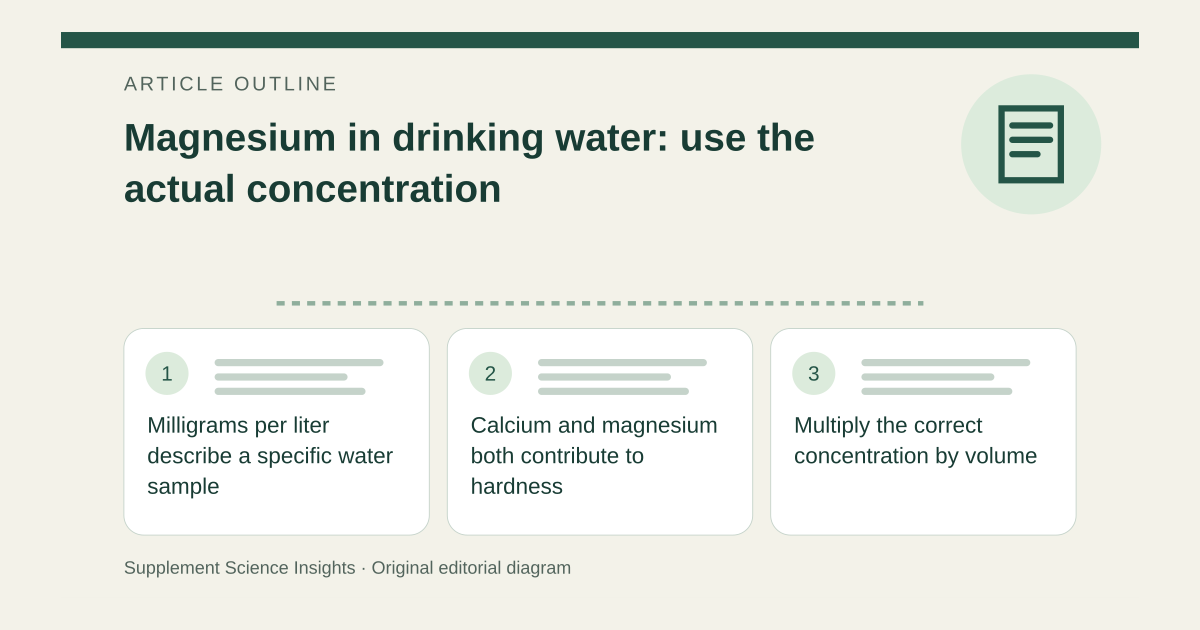
Milligrams per liter describe a specific water sample
NIH ODS notes substantial variation in magnesium content of drinking waters. To estimate intake, use the magnesium concentration for the actual supply or product and the volume consumed. [1][2]
A general claim that mineral water contains magnesium cannot provide a reliable daily amount without those numbers. [1][2]
Calcium and magnesium both contribute to hardness
USGS explains water hardness in terms of dissolved calcium and magnesium, often expressed as milligrams per liter as calcium carbonate. That reporting convention is not a statement that the same number is milligrams of magnesium. [1][2]
Do not use total hardness as an elemental magnesium dose. A water-quality report may provide the separate concentration needed for a nutritional calculation. [1][2]
Multiply the correct concentration by volume
Imagine a report specifically lists magnesium at 10 mg/L. Drinking 2 L supplies 20 mg from that water; substituting a total-hardness number would answer a different question.
| Detail | Interpretation |
|---|---|
| Magnesium mg/L | Nutrient concentration |
| Hardness as CaCO3 | Different reporting basis |
| Concentration × volume | Estimated contribution |
Sources for this article
- Magnesium - Health Professional Fact Sheet
Source consulted: 2026-09-18. This is a reference resource, not a claim that we conducted the studies or tested a product. - Hardness of Water | U.S. Geological Survey
Source consulted: 2026-09-18. This is a reference resource, not a claim that we conducted the studies or tested a product.